
AED Log alternative: one flat rate for the fleet
Compare AED Log with ReadyAED for an AED program. Every AED Log fact comes from the AED Log pages.
AED Log is software-only AED tracking with published tier prices and a manual inspection flow. ReadyAED is a software-only register for any AED brand, priced as one flat rate instead of per-device tiers.
This page compares the two for a facility or safety manager who runs an AED (automated external defibrillator) program. Every fact about AED Log cites the AED Log home page or pricing page.
Last verified 23 September 2026.
Who AED Log is best for
AED Log fits a small fleet that wants a published price and a simple register.
The pricing page shows a device-count selector with 22 tiers from 1 AED to 1,000 or more, and a running price for the tier you pick. Every tier includes unlimited users and locations.
The home page lists six feature blocks: inspection tracking, pad expiration, battery expiration, CPR and AED certification tracking, a mobile app, and a dashboard. Inspections are manual with QR codes.
A buyer who values those things gets real value from AED Log:
- Tier prices are published, including a low entry price for one AED.
- CPR and AED certification tracking is part of the feature list.
- The software is simple and has no hardware requirement.
The trade-off is fit, not quality. AED Log is built for a small fleet that keeps its own compliance records. ReadyAED is built for a program that needs an audit trail, a 90-day expiry view with reorder costs, and medical direction through partners.
ReadyAED vs AED Log: where we differ
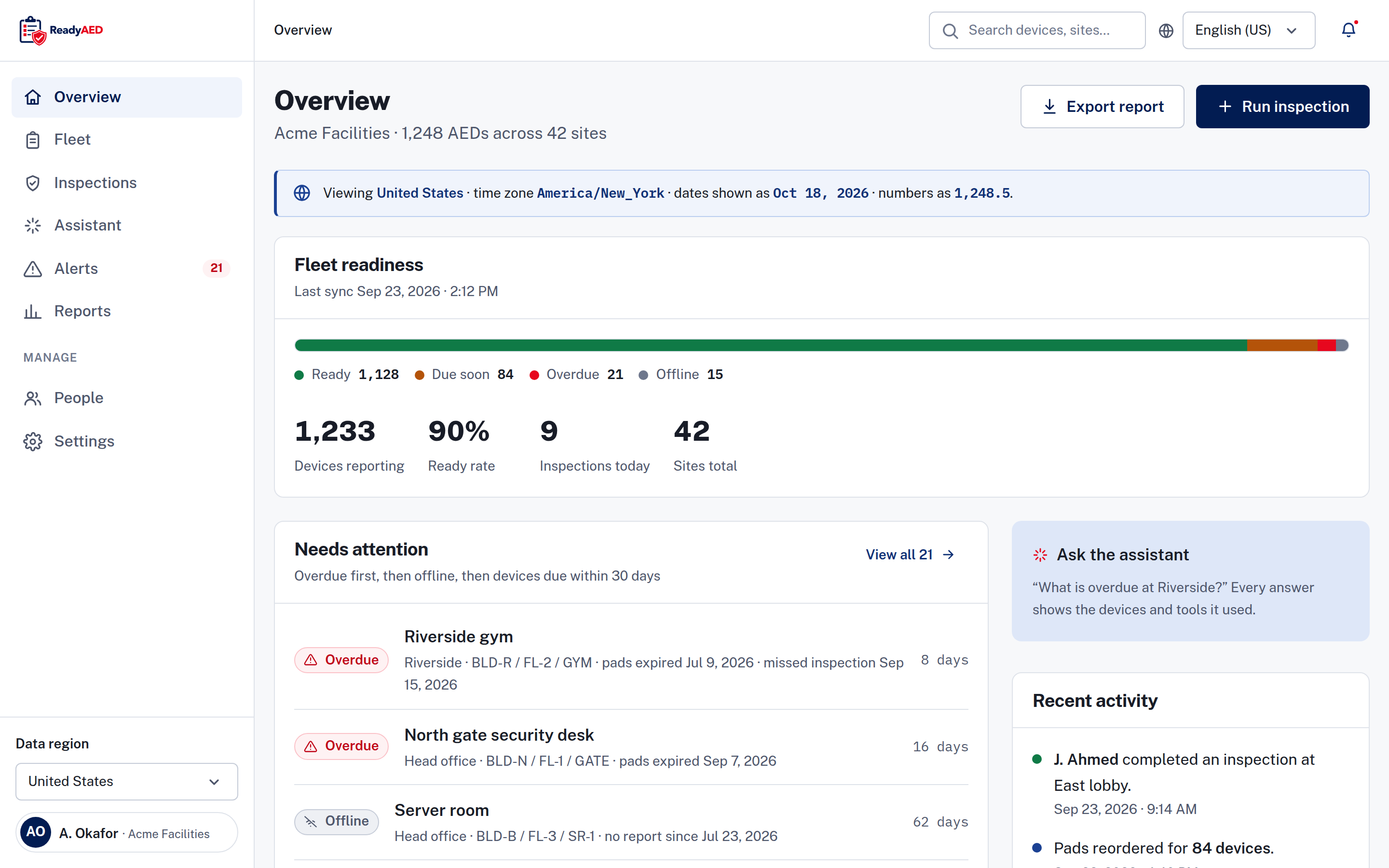
The table lists what a buyer looks for. Each AED Log cell describes what the AED Log pages show, and each ReadyAED cell describes the product.
| What a buyer looks for | ReadyAED | AED Log |
|---|---|---|
| The register | One register for AEDs of any brand, with serial number, site, location, status, pads expiry, battery percentage and last inspection date. | A dashboard and a register are shown on the home page, and the home page shows a row of AED manufacturer logos. |
| Inspections | Five checklist lines on a phone-first screen. Every line is answered Pass, Fail or N/A, and a failed line adds a follow-up task. Notes and photos are optional. | Inspections are manual with QR codes, as the pages describe. |
| Expiry and consumables | A 90-day view of pads, batteries and rescue kits, with the devices affected and the reorder cost. Purchase orders are created in the app, and fulfilment is by partners. | Pad expiration and battery expiration are listed as separate feature blocks. |
| Staff certifications | The register covers AED units, pads, batteries and inspections. Staff certification tracking is not part of the product. | CPR and AED certification tracking is a listed feature. |
| Records | A device record with inspection history, event history and documents, and an audit trail for user and system events. Exports: report, CSV and device history. | A dashboard is shown. An audit trail is not described on the pages reviewed. |
| Medical direction | Delivered through licensed physician partners. ReadyAED does not practice medicine. | Medical direction and compliance services are not listed on the pages reviewed. |
| The commercial model | One flat rate for the software, not per device. The rate is approved price. Software only, with no hardware or consumables for sale. | Flat tiers with published prices. Every tier includes unlimited users and locations. Custom pricing applies above 999 AEDs. |
The ReadyAED column describes the product as reviewed. The AED Log column repeats what the AED Log pages state, checked on the date at the top of this page. Where the pages do not state a fact, the cell says so instead of guessing.
Medical direction is delivered through licensed physician partners. ReadyAED does not practice medicine. named medical-direction partners and the markets they cover legal-approved disclaimer text this passage needs legal sign-off
How the two pricing models differ
ReadyAED charges one flat rate. AED Log charges a flat tier price based on the number of AEDs.
ReadyAED charges one flat rate for the software, not per device. The rate is approved price. We sell no hardware and no consumables, and pads and batteries are fulfilled by partners.
AED Log publishes tier prices on its own pricing page, checked on 23 September 2026, as displayed; the AED Log page names no currency. A single AED costs $9.50 per month or $114 per year. Two to 5 AEDs cost $228 per year, and 10 AEDs cost $55 per month or $660 per year. Custom pricing applies above 999 AEDs. Every tier includes unlimited users and locations.
Both models are legitimate. They charge in different shapes. ReadyAED charges one flat rate for the software. AED Log charges a flat tier price based on the number of AEDs. Neither page replaces a written quote for your fleet. Ask each supplier for the full price in writing, and ask what the tier covers.
Three questions sort a published tier price: what counts as one AED, when the tier changes as the fleet grows, and how cancellation works. ReadyAED charges one flat rate for the software, and the rate is approved price. An AED Log buyer can read the tier selector on the pricing page and ask what happens when the fleet crosses a tier line.
Mixed fleet and data out
One register for any brand, and a clear line on what leaves the product.
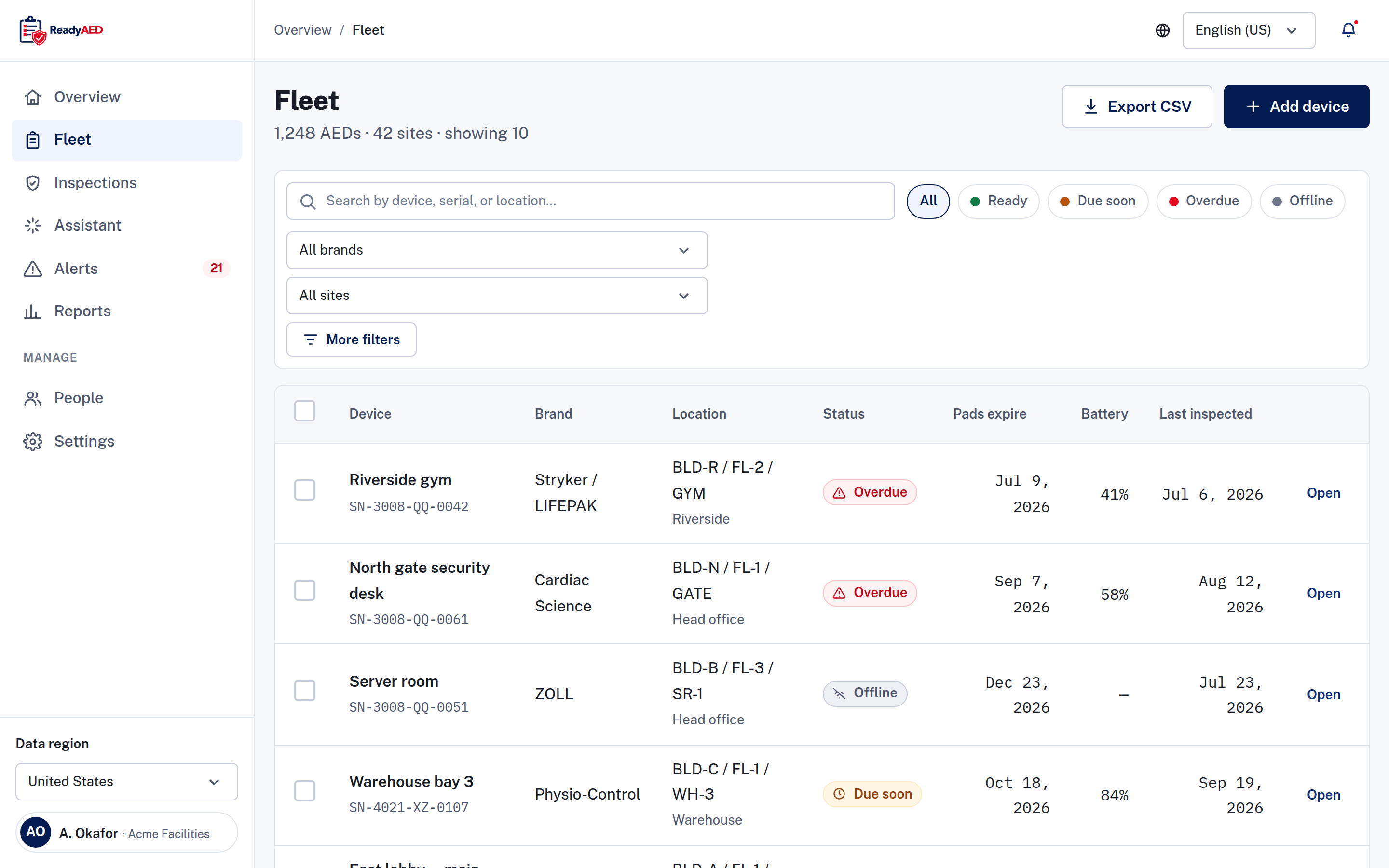
A mixed fleet is an AED program with units from more than one brand. The register keeps every unit in one list. Mixed fleet covers the register, the Brand column and the filter by brand or site.
On data out, the line is clear. There is no connector between ReadyAED and AED Log, and company SSO is the only integration shown in the product today. Exports are report, CSV and device history. REST API, webhooks and HRIS or EHS integrations are not confirmed yet: product confirmation of REST API, webhooks and HRIS/EHS integrations, with named systems.
Moving from AED Log to ReadyAED
Keep the AED Log plan until the register is complete.
Before the move, write down the tier the account sits in today and the date the term ends. That note sets the last date the old record must stay accurate.
- Keep the AED Log account and its term. Do not cancel anything on the strength of this page.
- Add each unit from the AED Log register to ReadyAED, one device at a time. Bulk import is not confirmed: confirmation of bulk import or migration tooling.
- Enter the fields the AED Log register holds: brand, model, serial number, asset ID, site, location, pads expiry and battery reading.
- Upload the manuals and service records that belong to each unit.
- Run the first inspections from ReadyAED and make sure that the register matches the AED Log list.
- When every line matches, retire the old record after your next audit.
When to choose AED Log
Choose AED Log if the fleet is small, if a published tier price matters to your budget, and if CPR and AED certification tracking belongs in the same tool as the unit list. Choose AED Log if the program keeps its own compliance records and does not need medical direction through a partner.
Choose ReadyAED if the register must carry a full audit trail, if you need the 90-day expiry view with reorder costs, or if medical direction through licensed physician partners is part of the program. Both answers are reasonable. The right answer follows the records you must keep.
Questions facility managers ask before an AED Log comparison demo
Does ReadyAED track CPR and AED certifications?
No. AED Log lists CPR and AED certification tracking. ReadyAED tracks the AED program: units, pads, batteries, rescue kits, inspections, documents and records. Staff certification stays with the system you use for training records.
Does ReadyAED connect to the AED Log data?
No. There is no connector between the two products. The move happens device by device, and bulk import is not confirmed: confirmation of bulk import or migration tooling.
Does ReadyAED publish prices?
ReadyAED charges one flat rate for the software, not per device. The rate is approved price. The AED Log prices on this page are AED Log's own published figures, checked on 23 September 2026, as displayed; the AED Log page names no currency.
ReadyAED vs AED Log: do we need to change our AED brands?
No. ReadyAED keeps one register for AEDs of any brand, and the software does not change the units you own.
How do we move from AED Log?
Keep the AED Log plan while you add devices to ReadyAED. The Fleet screen adds one device at a time. Retire the old record when every line matches, and keep the plan until the end of its term.
Where did the AED Log facts on this page come from?
Every AED Log fact cites the AED Log home page or pricing page, last verified 23 September 2026. If the pages change, we make sure that the facts still hold and update the date. If a fact cannot be confirmed on the AED Log pages, we mark it instead of publishing it.
Does the register handle several sites?
Yes. One account holds every site, and each device carries a site and a location path. The register filters by site, so a district or a campus reads as one list. Site staff are invited into the account.
Bring your fleet and the records you keep today
We show how one register holds every unit, how the four states read and what the audit trail keeps.
One flat rate covers the register for every brand, in place of the AED Log tiers. See Pricing for the commercial model and run your own numbers in the ROI calculator.