Members change, the program must not
A front desk team turns over through the year. The person who inspected the AED last month works somewhere else now. A program that lives in one head walks out with that person.
Keep every unit ready across studios, gym floors and pools, even when the front desk team changes.
A fitness facility runs on people who are not there for long. Members come and go, and the front desk and coaching teams rotate. The AEDs (automated external defibrillators) stay on the wall, and someone must keep them ready.
ReadyAED keeps one register for every unit across the clubs you run. A register is one list that holds every unit and its status. Your team sees the status of each AED and the next due date, whatever shift is on.
A front desk team turns over through the year. The person who inspected the AED last month works somewhere else now. A program that lives in one head walks out with that person.
The setting itself draws the risk. A study of cardiac arrests at public indoor facilities found that most happened during exercise. The staff on duty must know where the nearest AED sits and whether it is ready.
A club is several rooms: the main floor, a studio, a pool deck and a back office. Each room can hold an AED, and equipment moves between sites when a club refits.
A pad expires on a date, not on a busy day. A battery falls below range between inspections. Both sit behind a cabinet door until someone opens it.
A club operator needs the record to move with the front desk, not with one person. The list must show which units are ready and which are due, and a new staff member must find the answer in one screen. The pad and battery dates must surface before they become an inspection failure.
A study published in the Journal of the American College of Cardiology in 2013 looked at 849 cardiac arrests at public indoor facilities in Seattle and King County from 1996 to 2008. Survival to hospital discharge was 56% at traditional exercise facilities, 45% at alternative exercise sites and 34% at other public indoor locations. In 77% of the cases, the arrest happened during exercise. The study is context for the setting. ReadyAED makes no clinical claim.
The Centers for Disease Control and Prevention (CDC) reviewed US state law in effect on 30 June 2017. Fifteen states include health, fitness or athletic facilities in laws on targeted AED placement.
A unit on a wall is not a program. The pad date, the battery, the cabinet and the inspection record are. Those are the parts ReadyAED tracks.
A fitness floor is a public space with a fast staff cycle. A short phone checklist and a dated record are the parts that survive the turnover. The study above shows why the unit on the wall must be ready when someone reaches for it.
Last verified 24 September 2026. Sources: ACC press release on the JACC study "Cardiac arrest at exercise facilities" and the CDC Public Access Defibrillation (PAD) State Law Fact Sheet. The state-law statement is general information, not legal advice. legal-approved disclaimer text this passage needs legal sign-off
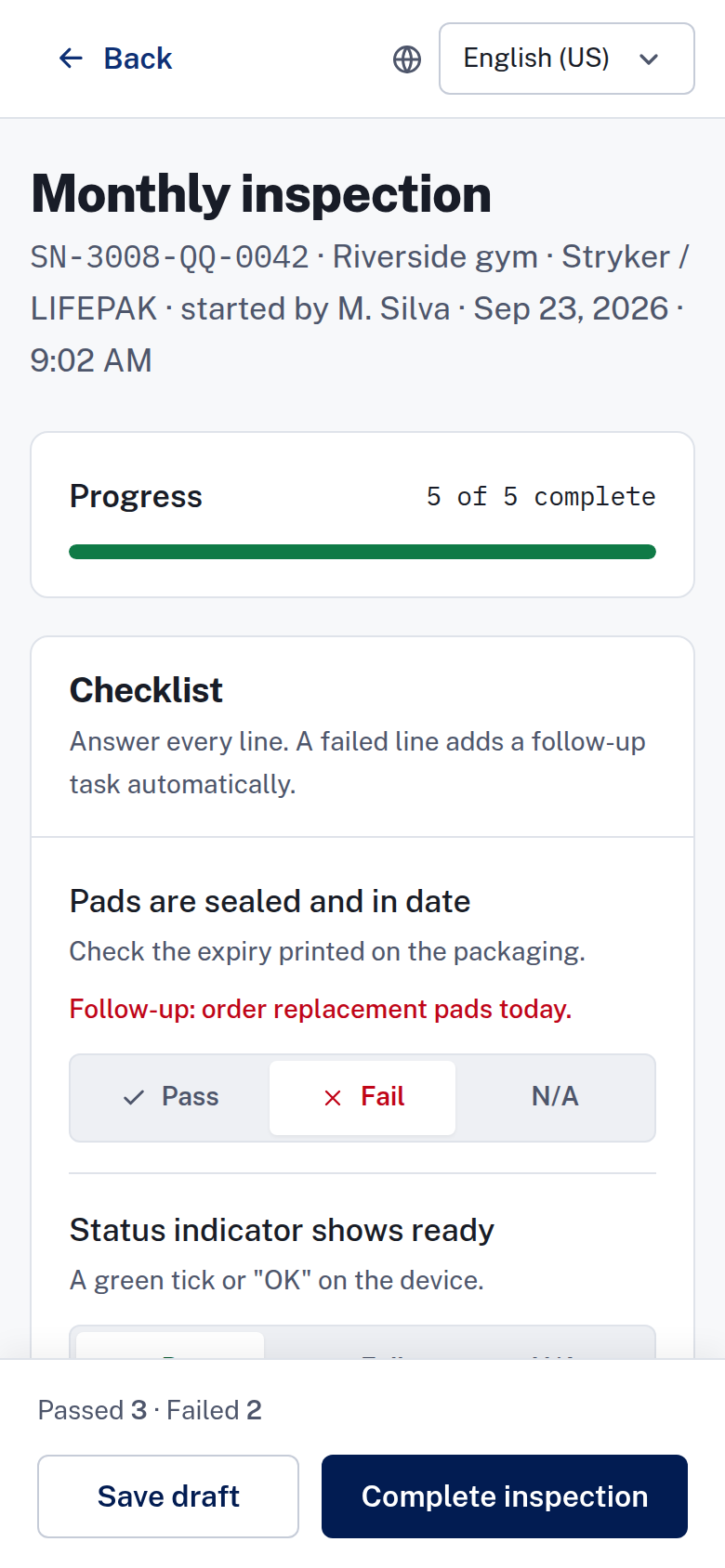
A staff member opens the five-line checklist in the browser on an Android or iOS phone. Every line takes an answer of Pass, Fail or N/A, and a failed line adds a follow-up task. Mobile inspections covers the flow.
Each club line shows the pads expiry and the battery level. The overview lists consumables that expire in the next 90 days, with the devices affected. Expiry & consumables tracking covers the dates and the reorder flow. Consumables are fulfilled by partners. ReadyAED sells no hardware or consumables.
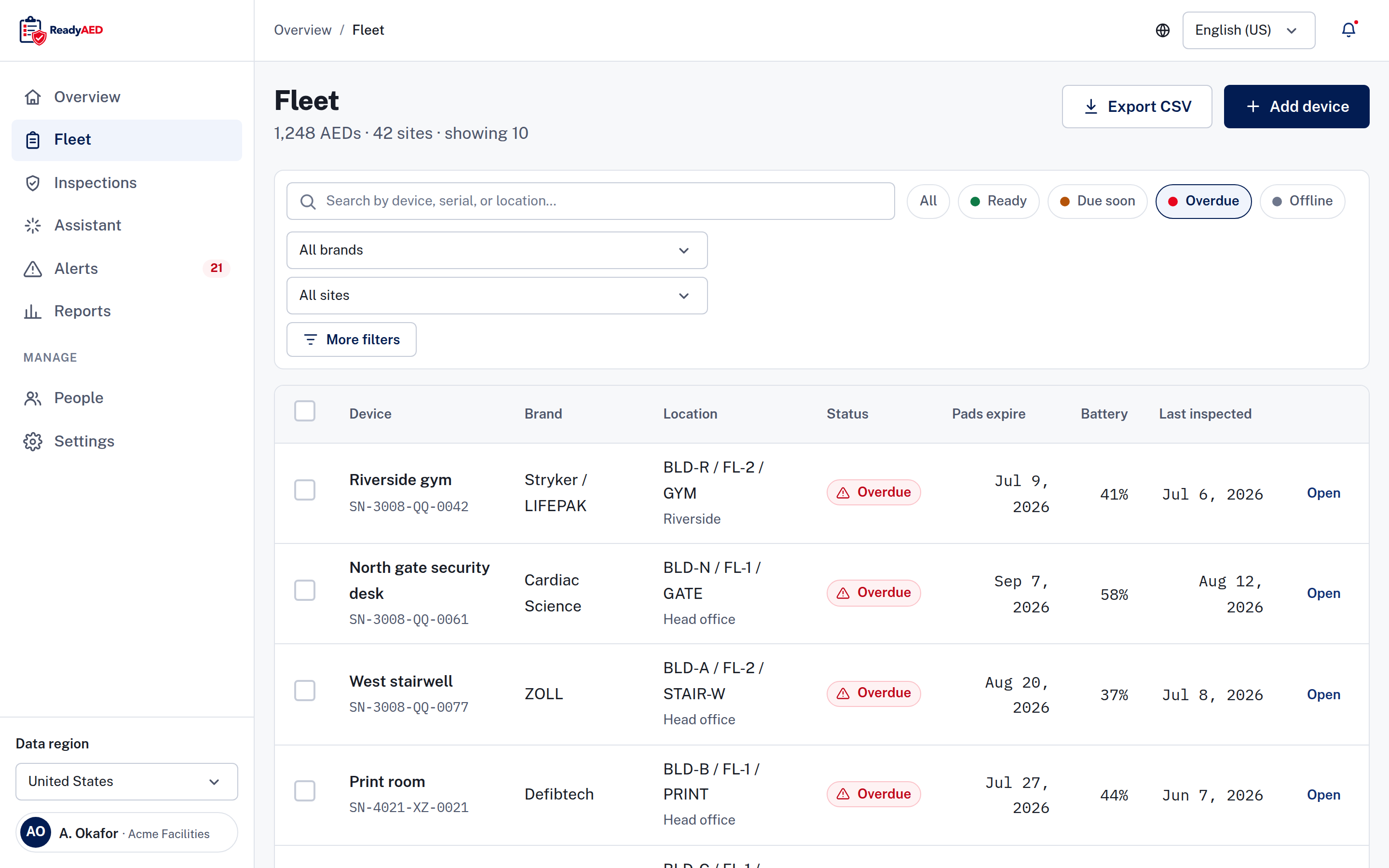
Every unit sits in one table, with serial number, site, location path, status, pads expiry, battery percentage and last inspection date. Filter by site to see one club at a time, or by status to see what needs action now. Readiness dashboard covers the view.
Any brand, one register. The device record holds the brand, model, serial number, asset ID (your own reference for the unit) and location, and the inspection history stays with the device. Every club uses the same four states: Ready, Due soon, Overdue and Offline (no report was received from the unit). Each state carries an icon and a word.
Fitness customer proof is not approved yet, so we mark the gap instead of filling it with an estimate.
Yes. One account holds every site, and each device record carries a site and a location path. Filter the register by site to see one club at a time. Each club keeps its own site and location path, so the district view and the single-club view come from the same register.
The inspection is five lines on one phone screen. Every line must be answered before the inspection is complete. The measured average is not published yet. measured average inspection time
Yes. Every line in the register shows pads expiry and battery percentage. The overview lists consumables that expire in the next 90 days, with the devices affected and a reorder action. A failed pads line adds a follow-up task to order replacement pads. Consumables are fulfilled by partners. ReadyAED sells no hardware or consumables.
The rules differ by state. Medical direction is delivered through licensed physician partners, and ReadyAED does not practice medicine. named medical-direction partners and the markets they cover legal-approved disclaimer text this passage needs legal sign-off
Site staff are invited into the account, and each device shows an assigned site custodian and a last inspector. The inspection history stays in the account, so a new team member picks up the record. The invite takes minutes, and the history is already there.
We show how one register holds units across studios and sites, how the four states read and where the records live. ReadyAED charges one flat rate for the software, not per device. See Pricing for the commercial model and the ROI calculator to run your own numbers. Exit and data portability: exit and data-portability commitment.
Other industries: Education, Retail and Healthcare. The Solutions hub lists the full set.