ReadyAED

AED management for healthcare: medical direction and clinical records

Keep inspection records, device history and the medical direction paper trail in one account, across hospitals, clinics and outpatient sites.

A health system runs AEDs (automated external defibrillators) in more places than a hospital. Clinics, outpatient centers, dental offices and staff gyms each hold units. Each site answers to its own manager and its own rules.

ReadyAED keeps the equipment record for every unit in one register. A register is one list that holds every unit and its status. Medical direction is delivered through licensed physician partners. ReadyAED does not practice medicine.

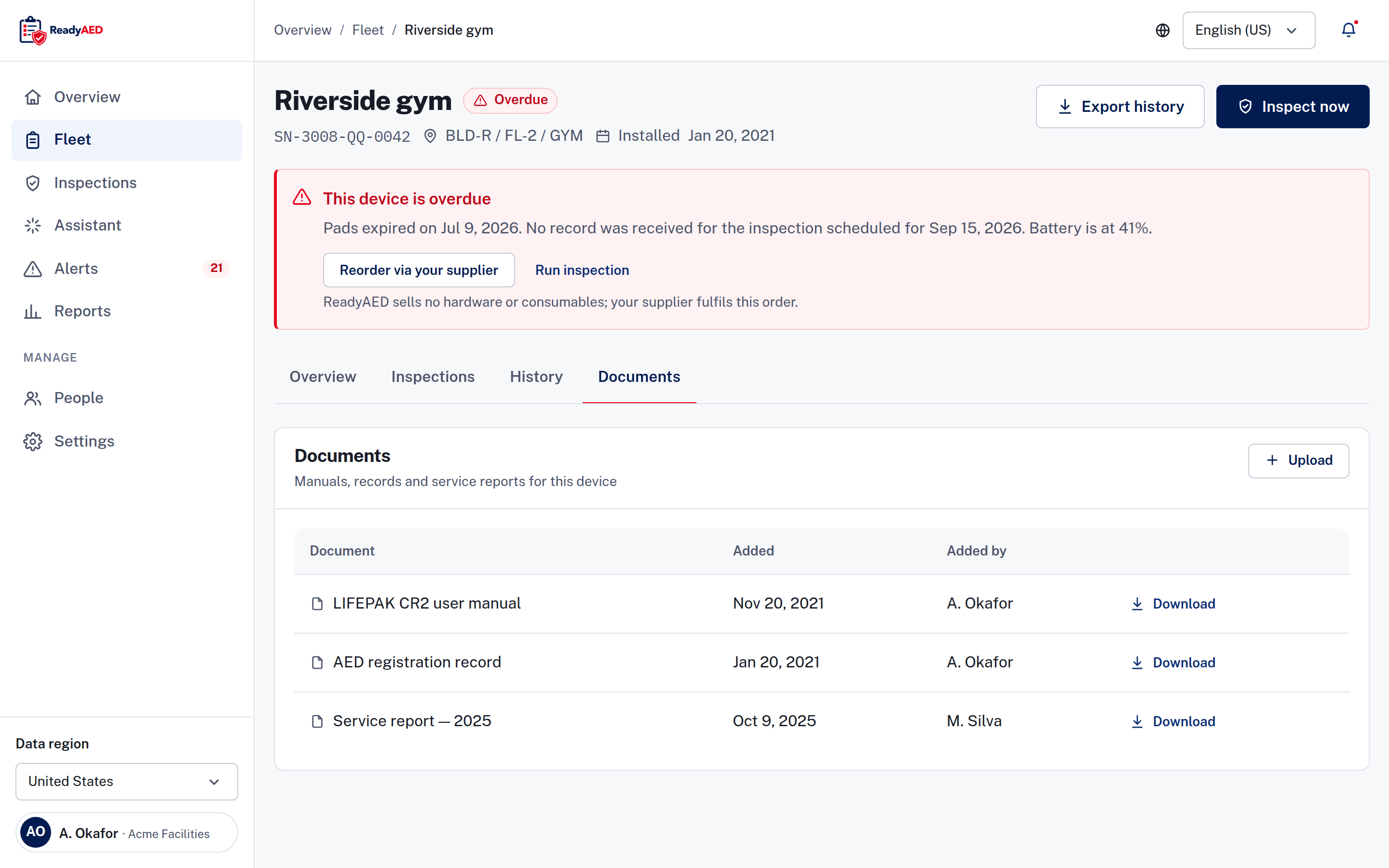
Device record with the Documents tab open, listing a user manual, an AED registration record and a service report for one AED, each with the date it was added. Sample data.

Oversight, records and rules: the healthcare problem

Medical direction needs a paper trail

A PAD program (public access defibrillation) can need a licensed physician or another medical authority to oversee it. That oversight leaves records: who authorized the program, who reviews it and when. When the paperwork sits with one coordinator, an inspection request starts a search.
Clinical use records sit apart from device records

When an AED is used in an emergency, one record goes to the clinical side and another goes to the equipment log. The inspection history says the pads were in date. The clinical use report says what happened. The two rarely meet in one system.

Small clinics do not have a hospital safety team

An outpatient clinic has a practice manager, not a safety department. The same person handles staffing, supplies and the AED. A process that fits a hospital does not fit a two-room clinic. A short checklist on a phone fits a two-room clinic better than a binder on a desk.

State oversight and reporting rules differ

Oversight and reporting requirements vary by state. Some states require a licensed health care provider or another medical authority to oversee a program. Some require each clinical use to be reported. A program that covers several states meets several rule sets.

What the compliance lead needs

A compliance or clinical lead needs one record that covers the equipment and the oversight. The record must name the device, the inspection, the reviewer and the date. It must also answer a request without a search across departments.

What the numbers say about oversight and outcomes

Oversight and reporting are written into many state laws

The Centers for Disease Control and Prevention (CDC) reviewed US state law in effect on 30 June 2017. In 20 states, law requires or encourages a licensed health care provider or another medical authority to oversee PAD programs. In 19 states, each clinical use of an AED must be reported to EMS, a licensed health care provider or another medical authority.

Most out-of-hospital cardiac arrests end in death

The CDC reports more than 356,000 out-of-hospital cardiac arrests in the United States each year. An estimated 70% to 90% of people die before they reach hospital.

Medical direction, stated exactly

Medical direction is delivered through licensed physician partners. ReadyAED does not practice medicine. The product has no physician-oversight screens, and no market or state coverage is confirmed yet. named medical-direction partners and the markets they cover legal-approved disclaimer text this passage needs legal sign-off

What this means for a health system

The rule set follows the state, not the building. A system that runs sites in several states keeps one program record and meets several reporting duties. The register holds the equipment side of that record, and the exports carry it to the reviewer.

Last verified 24 September 2026. Source: CDC Public Access Defibrillation (PAD) State Law Fact Sheet.

The features that matter in a health system

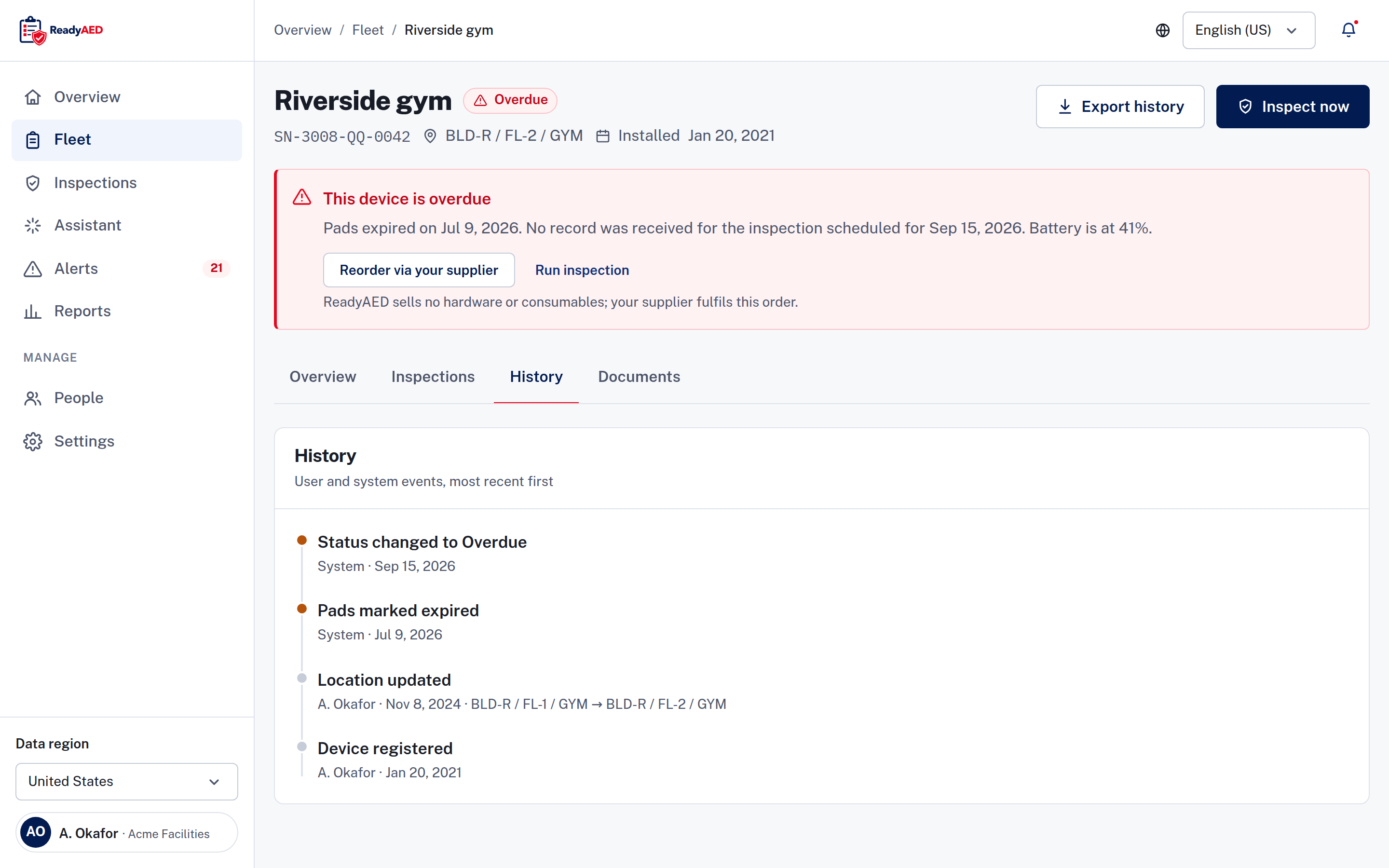
Device detail screen with the History tab open, showing dated user and system events for one AED, including a status change and a scheduled inspection. Sample data from the demo tenant.

Records that stay with the device

Every user and system event lands in the audit trail. The device record holds the inspection history as a timeline and as a table, with the date, inspector, result, battery reading and note. Compliance records covers the exports and the audit trail.

Medical direction through partners

Medical direction is delivered through licensed physician partners, and ReadyAED does not practice medicine. Medical direction explains what the partner model covers and how it links to your program records.

Pads and batteries before they expire

Every device line shows the pads expiry and the battery level. The overview lists consumables that expire in the next 90 days, with the devices affected. Expiry & consumables tracking covers the dates and the reorder flow. Consumables are fulfilled by partners. ReadyAED sells no hardware or consumables.

What is proven, and what is not

What we can show today

An audit trail records user and system events, device history and inspection history, and ReadyAED exports a report, a CSV file and the device history. Security posture, stated exactly: SOC 2 is in progress. A BAA (Business Associate Agreement) is available. See the Security & Trust Center.

What still needs approval

Healthcare customer proof and the partner list are not approved yet, so we mark the gaps instead of filling them with estimates.

  • customer quote and name — needs written customer approval
  • approved units under management and site counts
  • named medical-direction partners and the markets they cover

Questions compliance and clinical leads ask before a demo

Does ReadyAED provide medical direction?

No. Medical direction is delivered through licensed physician partners. ReadyAED does not practice medicine. The product has no physician-oversight screens. The partner list and its coverage are not published yet. named medical-direction partners and the markets they cover legal-approved disclaimer text this passage needs legal sign-off

How do we keep a clinical record of AED use?

ReadyAED keeps the inspection records, the device history and the event timeline for each unit. Clinical use reporting rules vary by state. The AED Law Center collects general information on US AED law. The guidance there is general information, not legal advice. legal-approved disclaimer text this passage needs legal sign-off

Can clinic staff inspect an AED from a phone?

Yes. The inspection flow runs in the browser on an Android or iOS phone. It has five checklist lines, and every line must be answered before the inspection is complete. A failed line adds a follow-up task automatically. Photos and notes are optional and stay with the inspection.

Does ReadyAED hold patient records?

The device record holds equipment and inspection data, not clinical notes. A BAA (Business Associate Agreement) is available. Read HIPAA and data handling for the data detail.

Does ReadyAED work across hospitals and outpatient sites?

Yes. One account holds every site, and each device record carries a site and a location path. Site staff are invited into the account, and a site custodian and a last inspector are shown on each device. The site filter covers a hospital campus and a single clinic in the same account.

Bring your site list and your oversight questions

We show how one account holds the equipment records for every site, how the audit trail reads and where the medical direction paperwork fits. ReadyAED charges one flat rate for the software, not per device. See Pricing for the commercial model and the ROI calculator to run your own numbers. Exit and data portability: exit and data-portability commitment. See Medical direction explained for the partner model.

Other industries: Manufacturing, Government and Education. The Solutions hub lists the full set.