Many stores, one program
A district holds a dozen stores or more. Each one buys an AED when the budget allows, and each one keeps its own sheet. The regional manager holds a summary that goes stale between visits.
Keep one register for every store, with inspection records, expiry dates and maintenance evidence in one place.
A retail estate grows one store at a time. A new store opens with one AED (automated external defibrillator) by the checkout, and a refit adds a second unit in the stockroom. Each store manager keeps the local record.
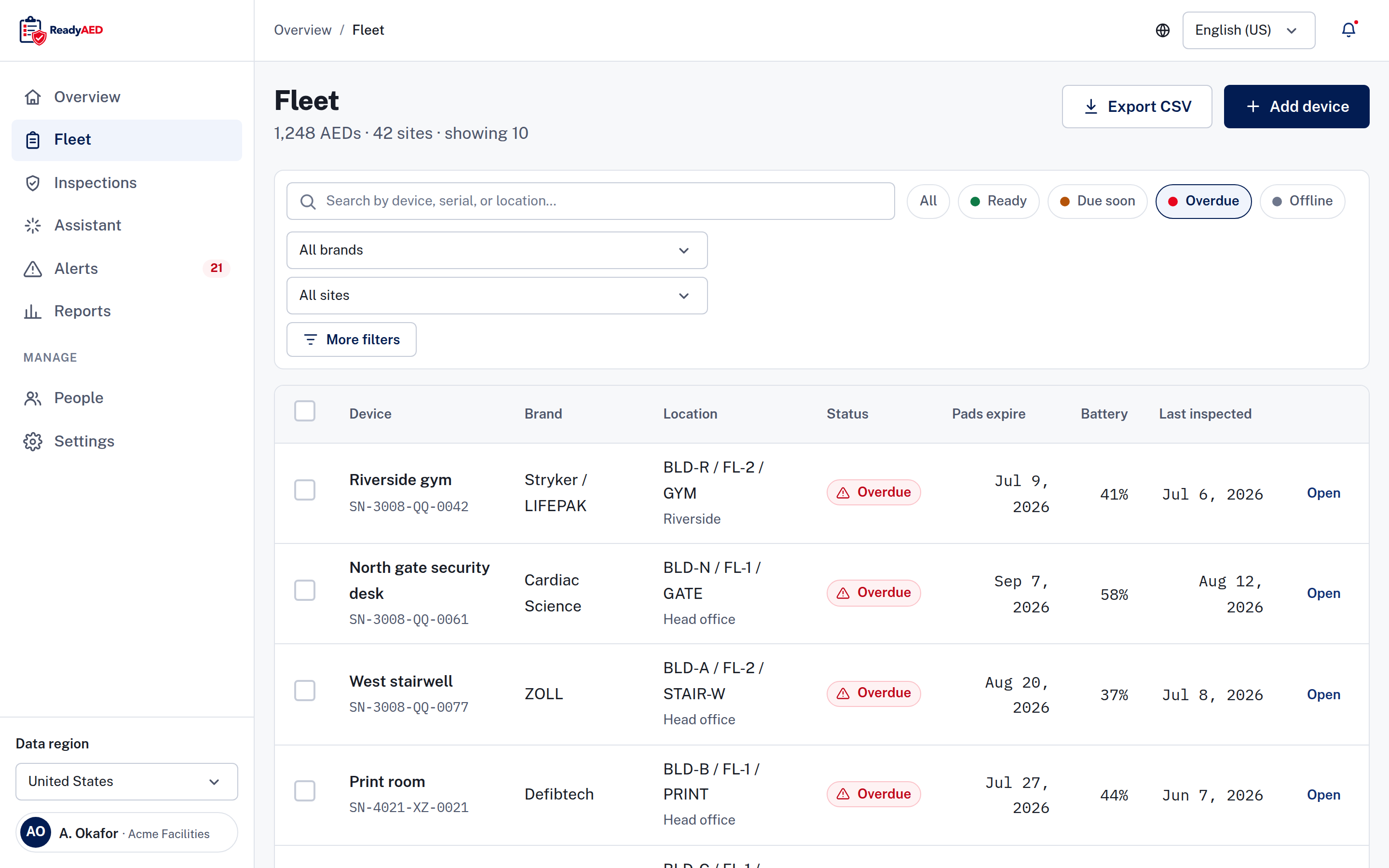
ReadyAED keeps one register for every unit in the estate. A register is one list that holds every unit and its status. Your team sees the status of each AED, the pads date and the last inspection, store by store.
A district holds a dozen stores or more. Each one buys an AED when the budget allows, and each one keeps its own sheet. The regional manager holds a summary that goes stale between visits.
Retail turnover is a fact of the job. A store manager moves to another branch, and the AED folder moves to a drawer. The next manager finds the unit but not the history.
A store has a public floor and a stockroom. An AED near the checkout serves customers, and one in the back serves staff. Both need a place in the same register, with the same checklist. The public unit also carries the visibility question: staff and customers must find it fast.
Holiday trading and sale weekends push the monthly inspection down the list. The gap shows up later, at a district review or an insurance visit.
A retail operations lead needs one list that covers every store without a visit. The list must show which units are ready and which are due, and a district manager must see one store or the whole estate. The record must also move with the store, not with the manager who set it up.
The Centers for Disease Control and Prevention (CDC) reviewed US state law in effect on 30 June 2017. In 42 states, the law requires or encourages maintenance and testing of AEDs.
The same CDC review found that 45 states include AED use training for anticipated lay responders in law. A store team is exactly that group: people who are likely to be present when an emergency happens.
The American Heart Association reports about 10,000 cardiac arrests in US workplaces each year. The association cites a report from the Occupational Safety and Health Administration (OSHA). A store is a workplace and a public space at the same time.
A store inspection is a short task between customers. The register keeps the date, the inspector and the result for every store. When a district review asks a question, the answer comes from one account instead of twelve folders.
Last verified 24 September 2026. Sources: CDC Public Access Defibrillation (PAD) State Law Fact Sheet and American Heart Association CPR Facts and Stats. The state-law statement is general information, not legal advice. legal-approved disclaimer text this passage needs legal sign-off
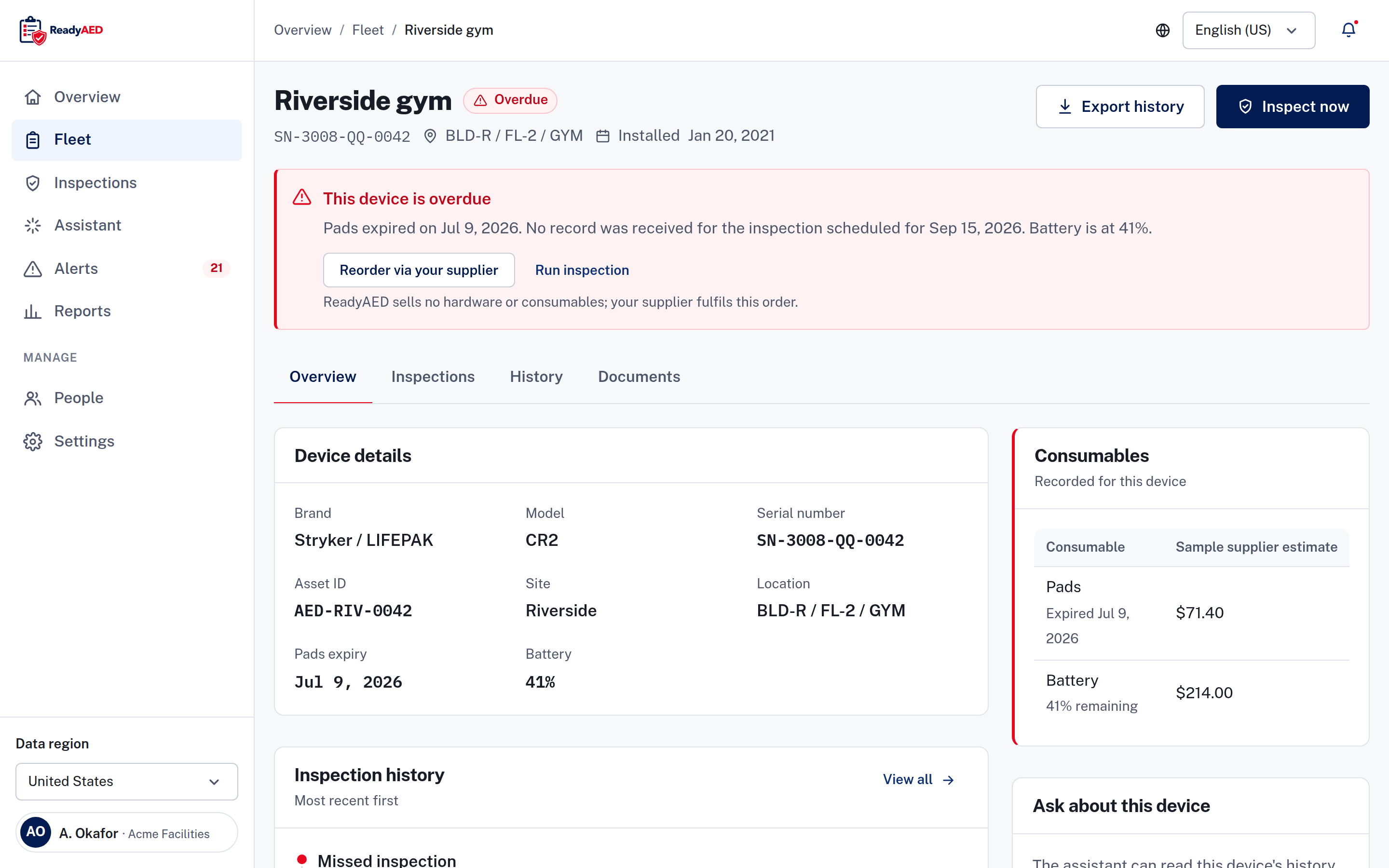
Every unit sits in one table, with serial number, store, location path, status, pads expiry, battery percentage and last inspection date. Filter by site to see one store at a time, or by status to see what needs action now. Readiness dashboard covers the view.
The register carries the pads expiry and the battery level for every store. The overview lists consumables that expire in the next 90 days, with the devices affected. Expiry & consumables tracking covers the dates and the reorder flow. Consumables are fulfilled by partners. ReadyAED sells no hardware or consumables.
The account holds an audit trail of user and system events. ReadyAED exports a report, a CSV file and the device history. Compliance records covers the exports and the audit trail.
Any brand, one register. A device record holds the brand, model, serial number, asset ID (your own reference for the unit) and location, and the inspection history stays with the device. Each store line carries the same four states: Ready, Due soon, Overdue and Offline (no report was received from the unit).
Retail customer proof is not approved yet, so we mark the gap instead of filling it with an estimate.
Yes. One account holds every site, and each device record carries a site and a location path. Filter the register by site to see one store at a time, or search by device, serial number or location. The site filter keeps each store's view separate, and the estate view stays in one register.
The store team does. Site staff are invited into the account, and each device shows an assigned site custodian and a last inspector. The five-line checklist runs in the browser on an Android or iOS phone. A failed line adds a follow-up task, and the task stays with the device.
The device record holds the inspection history, the event timeline and any uploaded documents. ReadyAED exports a report, a CSV file and the device history, so you can include the export in an audit pack. The CSV file opens in a spreadsheet for a district pack.
No. ReadyAED is software only. It sells no hardware or consumables. Consumables are fulfilled by partners, and you can create a purchase order in the app. Your store keeps its own supplier account.
The account holds the full record. A new manager is invited into the account and sees the register, the device records and the inspection history from day one. Nothing restarts, and the district view stays the same.
We show how one register holds units across the estate, how the four states read and where the records live. ReadyAED charges one flat rate for the software, not per device. See Pricing for the commercial model and the ROI calculator to run your own numbers. Exit and data portability: exit and data-portability commitment.
Other industries: Fitness, Transit and Corporate offices. The Solutions hub lists the full set.