ReadyAED

AED management for corporate offices: lobbies, floors and shared buildings

Keep one register for every AED across your buildings, with inspection records and expiry dates in one place.

An office estate spreads across floors and buildings. The lobby holds one AED (automated external defibrillator), the meeting floors hold others, and a multi-tenant building can hold units that different teams own. The facilities team keeps the program.

ReadyAED keeps one register for every unit you manage. A register is one list that holds every unit and its status. Your team sees the status of each AED, the pads date and the last inspection, building by building.

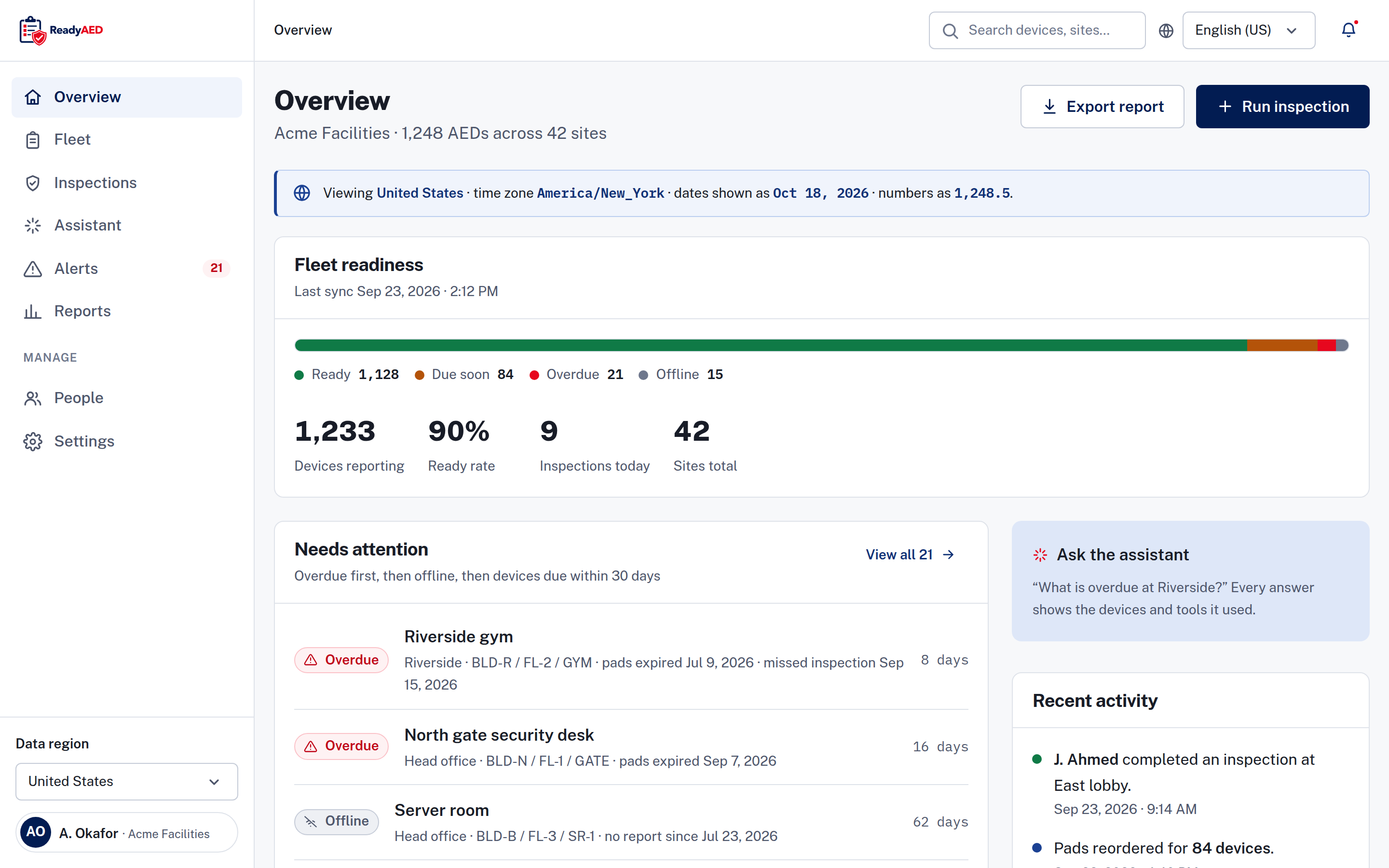
Readiness dashboard with sample data: a readiness meter, a summary strip and a needs attention list across several office buildings.

An office estate hides its AEDs on purpose

One facilities team, many floors

A company adds a floor or a building and the AED list grows. The lobby unit is easy to remember. The unit in the meeting-room corridor on floor six is easy to forget. The register makes the list one job instead of five.
Response depends on the nearest responder

In a cardiac emergency, the time to the nearest AED matters. The American Red Cross reports that survival chances decrease by about 10% for every minute that CPR and AED use are delayed. The team on the scene must find a ready unit fast.

Records split between landlord and tenant

In a multi-tenant building, the landlord can own the cabinet and the tenant can own the unit. The inspection record and the maintenance history split along the same line. A review then asks both sides for their part. The register can show one unit per owner, or one program for the whole building.

The program outlives the safety lead

The facilities lead who set up the program moves on. The register, the schedule and the supplier details leave with that person unless the account holds them.

What the facilities team needs

A facilities team needs one list that covers every building without a walk. The list must show which units are ready and which are due, floor by floor. It must also answer a lease question, because the landlord and the tenant often split the record.

What the numbers say about the office setting

Minutes matter

The American Red Cross reports that survival chances decrease by about 10% for every minute that CPR and AED use are delayed. The distance from a desk to a ready unit is part of that clock.

Cardiac arrests happen at work

The American Heart Association reports about 10,000 cardiac arrests in US workplaces each year. The association cites a report from the Occupational Safety and Health Administration (OSHA).

Most out-of-hospital cardiac arrests end in death

The Centers for Disease Control and Prevention (CDC) reports that an estimated 70% to 90% of people who have an out-of-hospital cardiac arrest die before reaching hospital.

What this means for an office estate

An office AED sits close to the people who need it, and the nearest responder is a colleague. The register keeps the unit ready and the record current. That is the part the facilities team can control between drills.

Last verified 24 September 2026. Sources: American Heart Association CPR Facts and Stats, American Red Cross CPR Facts & Statistics and the CDC Public Access Defibrillation (PAD) State Law Fact Sheet.

The features that matter for an office estate

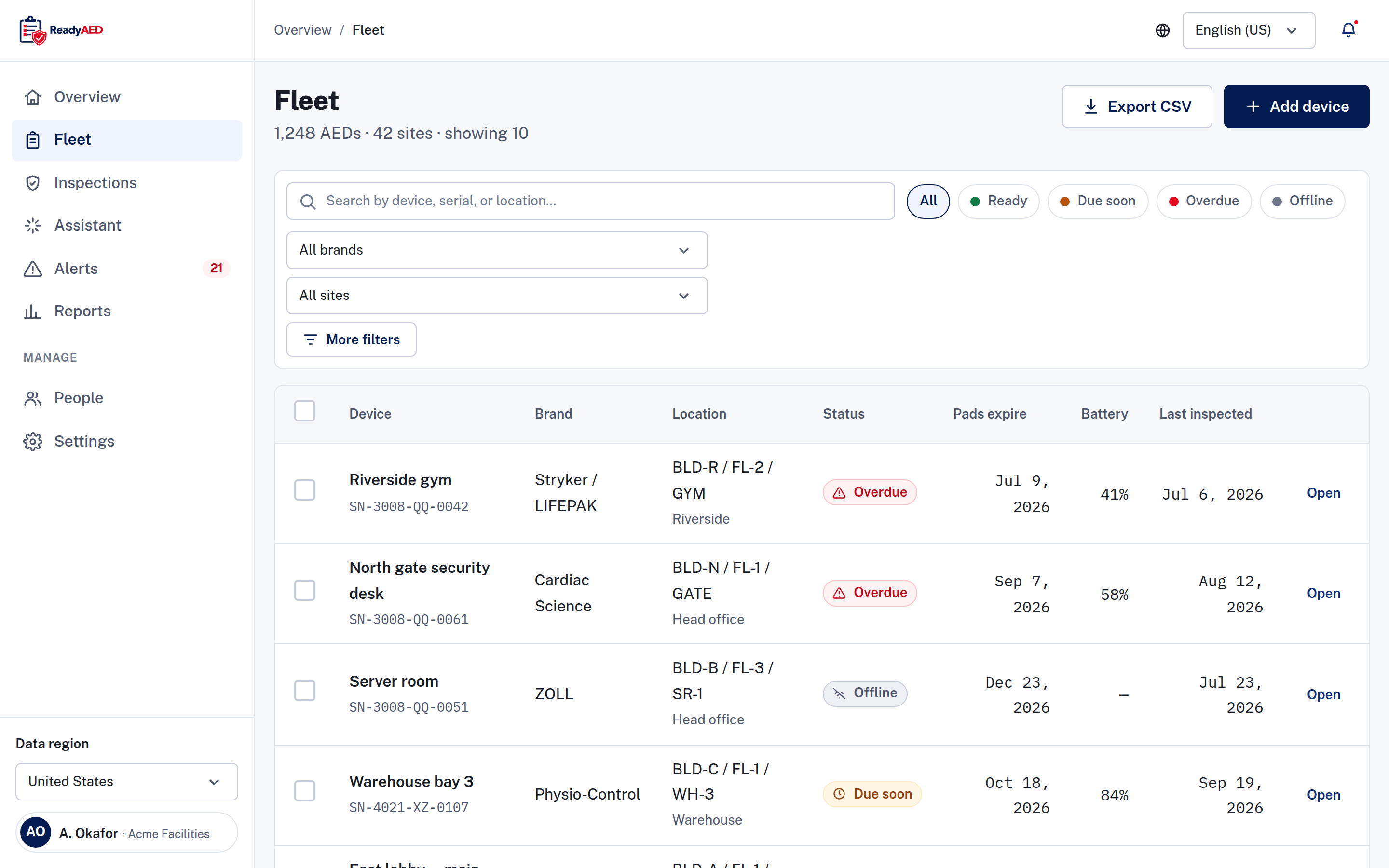
Fleet register listing AEDs from several manufacturers, with filters for Ready, Due soon, Overdue and Offline and rows showing Overdue, Due soon and Offline statuses. Sample data.

Every floor on one screen

Every unit sits in one table, with serial number, building, location path, status, pads expiry, battery percentage and last inspection date. Filter by site to see one building at a time, or by status to see what needs action now. Readiness dashboard covers the view.

Checks between meetings

A team member opens the five-line checklist in the browser on an Android or iOS phone. Every line takes an answer of Pass, Fail or N/A, and a failed line adds a follow-up task. Mobile inspections covers the flow.

Pads and batteries before they expire

Pads expiry and battery level appear on every line of the register. The overview lists consumables that expire in the next 90 days, with the devices affected. Expiry & consumables tracking covers the dates and the reorder flow. Consumables are fulfilled by partners. ReadyAED sells no hardware or consumables.

What is proven, and what is not

What we can show today

Any brand, one register. A device record holds the brand, model, serial number, asset ID (your own reference for the unit) and location, and the inspection history stays with the device. Every unit, on every floor, shows one of four states: Ready, Due soon, Overdue and Offline (no report was received from the unit).

What still needs approval

Corporate office customer proof is not approved yet, so we mark the gap instead of filling it with an estimate.

  • customer quote and name — needs written customer approval
  • approved units under management and site counts

Questions facilities leads ask before a demo

Can ReadyAED cover several office buildings?

Yes. One account holds every site, and each device record carries a site and a location path (building, floor, room). Filter the register by site to see one building at a time. The site filter covers a head office and a branch in the same account.

Who owns the AED records, the landlord or the tenant?

The account holds the records for the devices you manage. Each device shows an assigned site custodian and a last inspector, and site staff are invited into the account. A landlord and a tenant can hold separate accounts for separate units, or one account for a shared program. The record follows the account, not the lease.

How do we keep records current when people leave?

Site staff are invited into the account, and each device shows an assigned site custodian and a last inspector. The inspection history stays in the account, so a new team member picks up the record. The register shows the last inspector for every unit.

Where does the register fit with our emergency plan?

The register holds the equipment side: the unit list, the inspection records and the device history. Your emergency plan, your floor wardens and your first-aid training stay yours. The register and the plan work together.

Can we start with one building and add more later?

Yes. You add devices one at a time. Bulk import and migration tooling are not confirmed: confirmation of bulk import or migration tooling

What does the law require for office AEDs?

The rules differ by state. The AED Law Center collects general information on US AED law. The guidance there is general information, not legal advice. The law center pages are written for program owners, not for lawyers. legal-approved disclaimer text this passage needs legal sign-off

Bring your building list

We show how one register holds units across floors and buildings, how the four states read and where the records live. ReadyAED charges one flat rate for the software, not per device. See Pricing for the commercial model and the ROI calculator to run your own numbers. Exit and data portability: exit and data-portability commitment.

Other industries: Manufacturing, Retail and Transit. The Solutions hub lists the full set.