A network, not one building
A region holds dozens of stations and several depots. A unit goes in when a station is refurbished or when a grant allows. The asset list grows across teams and spreadsheets.
Track every AED across stations and depots, with inspection records and expiry dates in one register.
A transit network is a line of buildings. Stations, interchanges, depots and offices each hold AEDs (automated external defibrillators) for staff and for the public. Each site has its own team and its own routine.
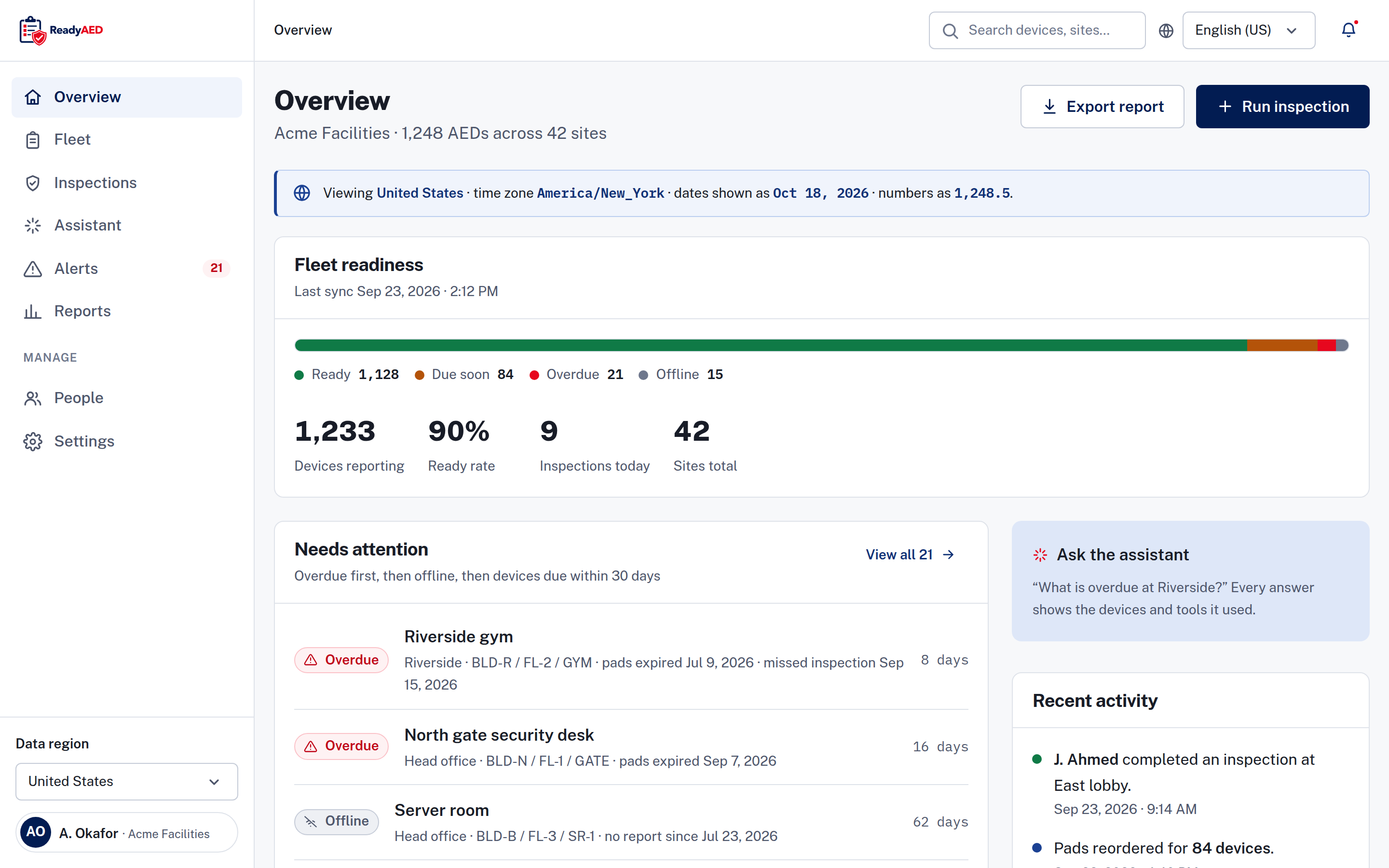
ReadyAED keeps one register for every unit in the network. A register is one list that holds every unit and its status. Your team sees the status of each AED, the pads date and the last inspection, station by station.
A region holds dozens of stations and several depots. A unit goes in when a station is refurbished or when a grant allows. The asset list grows across teams and spreadsheets.
An AED on a platform serves anyone nearby. That makes the cabinet location, the signage and the ready state part of the service, not a back-office detail. A unit behind a locked door is not public access. The register shows the location path for every unit, so the nearest cabinet is easy to name.
Station staff, cleaners and security teams work in shifts. The person who inspects a unit on one shift is not the person on the next. The record must travel with the device, not with the person.
Inspection sheets live at the depot that owns the unit. When an incident review or a funding report asks for a full picture, someone gathers sheets from several sites.
A transit safety lead needs one view of the network and one record per unit. The view must show which units are ready and which are due, station by station. The record must also show that a public unit was inspected, because the public depends on it.
The Centers for Disease Control and Prevention (CDC) cites a 2018 study that reported AED use at 10.8% in public settings before emergency medical services arrive. The unit can be close and still go unused.
The American Heart Association reports that 16.3% of out-of-hospital cardiac arrests happen in public settings. Homes hold the largest share, and public places come second.
In 33 states, law sets up an AED registry or requires notification of an AED to the EMS system. In 29 states, the person who uses an AED must call 9-1-1 and activate the EMS system.
Public access works when a unit is in reach and ready to use. The register holds the location and the status, and the inspection record shows the work behind both. A low public use rate does not change the duty to keep the unit ready.
Last verified 24 September 2026. Sources: CDC Public Access Defibrillation (PAD) State Law Fact Sheet and American Heart Association CPR Facts and Stats. The state-law statement is general information, not legal advice. legal-approved disclaimer text this passage needs legal sign-off
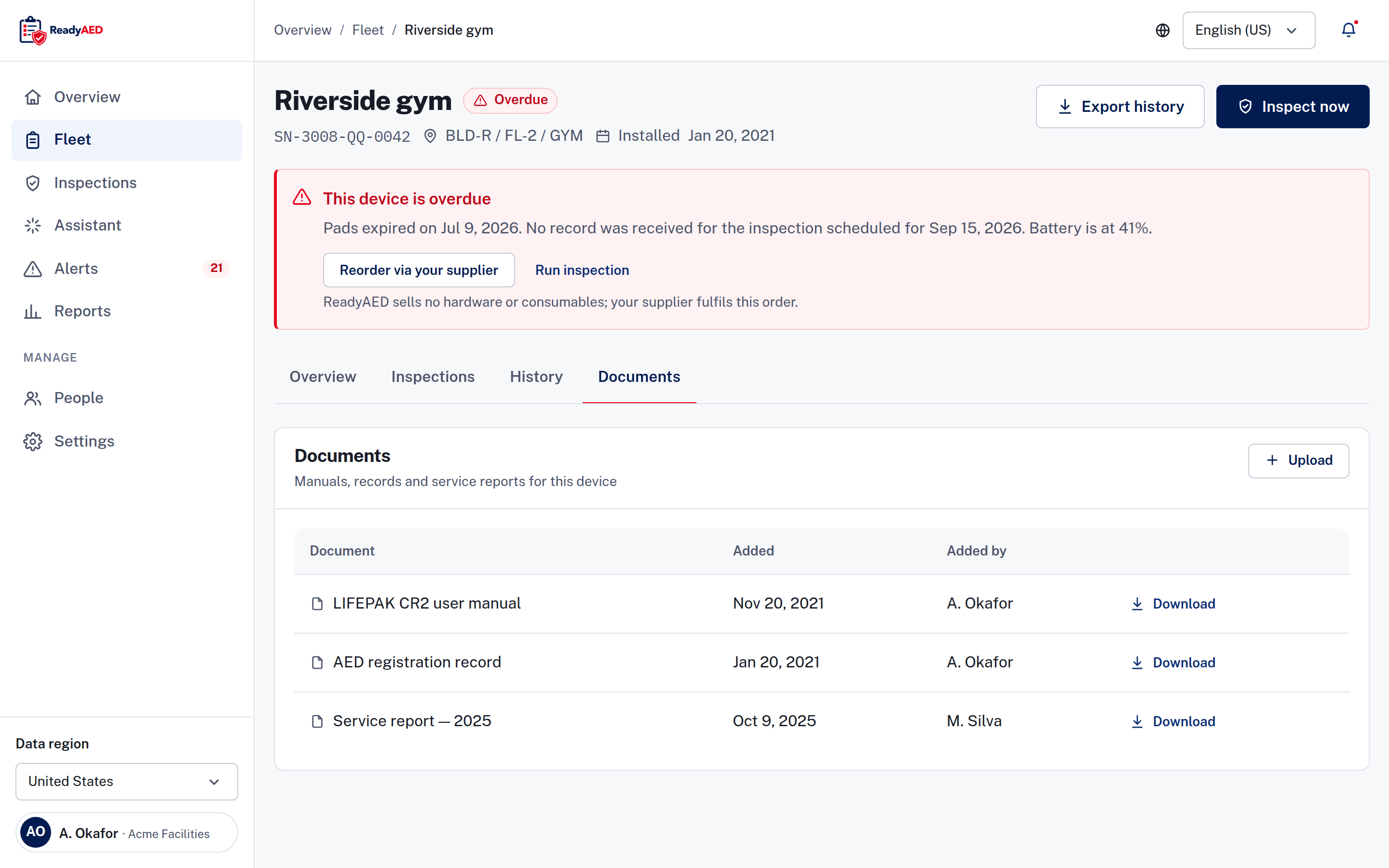
Every unit sits in one table, with serial number, station or depot, location path, status, pads expiry, battery percentage and last inspection date. Filter by site to see one station at a time, or by status to see what needs action now. Readiness dashboard covers the view.
A staff member opens the five-line checklist in the browser on an Android or iOS phone. Every line takes an answer of Pass, Fail or N/A, and a failed line adds a follow-up task. Mobile inspections covers the flow.
The audit trail covers user and system events, and each unit keeps its own history. The device record also holds uploaded documents, such as the unit's registration record and service reports. Compliance records covers the exports and the audit trail.
Any brand, one register. A device record holds the brand, model, serial number, asset ID (your own reference for the unit) and location, and the inspection history stays with the device. Every station and depot unit reads from the same four states: Ready, Due soon, Overdue and Offline (no report was received from the unit).
Transit customer proof is not approved yet, so we mark the gap instead of filling it with an estimate.
Yes. One account holds every site, and each device record carries a site and a location path. Filter the register by site, or search by device, serial number or location to see one station at a time. The site filter covers a station and a depot in the same account.
The device record keeps the event timeline and the inspection history, and documents upload to the device. Some states require clinical use reporting to EMS or a medical authority. The AED Law Center collects general information on US AED law. The guidance there is general information, not legal advice. The export covers a report, a CSV file and the device history. legal-approved disclaimer text this passage needs legal sign-off
No. ReadyAED keeps the register, the inspection records and the device history, and it exports a report, a CSV file and the device history. Registry and notification requirements vary by state. Make sure that you know what your agency must send. legal-approved disclaimer text this passage needs legal sign-off
Yes. The five-line checklist runs in the browser on an Android or iOS phone. Every line must be answered before the inspection is complete, and a failed line adds a follow-up task. Photos and notes are optional and stay with the inspection.
The product shows a device state called Offline, which means no report was received from the unit. It is not an offline working mode. The product interface marks the device state, not the app. Offline inspection support is not confirmed: confirmation that inspections work without a network, and how records sync
We show how one register holds units across a network, how the four states read and where the records live. ReadyAED charges one flat rate for the software, not per device. See Pricing for the commercial model and the ROI calculator to run your own numbers. Exit and data portability: exit and data-portability commitment.
Other industries: Government, Retail and Corporate offices. The Solutions hub lists the full set.