A plant is many buildings
A site grows by addition. Building A gets a unit near the main entrance, the warehouse gets one by the loading bay, and the new office block gets two. Each area keeps its own log, and nobody holds the full list.
Track every AED across buildings, lines and shifts, with one status model and one record per device.
A manufacturing site is rarely one building. A plant adds a line, a warehouse and an office block over time. Each area buys an AED (automated external defibrillator) when a budget allows, and each unit arrives with its own paperwork.
The fleet grows one purchase at a time, and the records spread with it. ReadyAED keeps one register for AEDs of any brand. A register is one list that holds every unit and its status. Your team sees every unit, its status and its next due date in one place.
A site grows by addition. Building A gets a unit near the main entrance, the warehouse gets one by the loading bay, and the new office block gets two. Each area keeps its own log, and nobody holds the full list.
The person who inspects the AED on day shift is not the person on night shift. Handover notes mention the inspection, but the pads date and the battery reading sit in a logbook or a spreadsheet on one desk. If the day-shift lead is away, the night team works from memory.
A replacement brings a new brand and new pad packaging. Inspectors meet different status lights and different cabinets on the same site. A checklist that fits one model does not fit the next.
A safety audit or an insurance review asks for the inspection record of one unit. The answer sits in more than one file, and someone must gather the pages before the meeting. A missing page reads as an inspection that never happened, even when the work was done.
A plant safety lead needs one view of the fleet. That view must answer three questions: which units are ready, which are due and which need action now. It must cover every building and every shift without a separate file for each area. The register must also survive a handover, because the next lead inherits the program.
OSHA standard 29 CFR 1910.151(b) states that, when no infirmary, clinic or hospital is near, a person or persons must be adequately trained to render first aid. The rule covers first aid, not software. Make sure that you know what your own site must provide. legal-approved disclaimer text this passage needs legal sign-off
The American Heart Association reports about 10,000 cardiac arrests in US workplaces each year. The association cites a report from the Occupational Safety and Health Administration (OSHA). The people on site are the first to reach for the nearest unit.
The Centers for Disease Control and Prevention (CDC) reports more than 356,000 out-of-hospital cardiac arrests in the United States each year. An estimated 70% to 90% of people die before they reach hospital.
Last verified 24 September 2026. Sources: American Heart Association CPR Facts and Stats, OSHA 29 CFR 1910.151 and the CDC Public Access Defibrillation (PAD) State Law Fact Sheet.
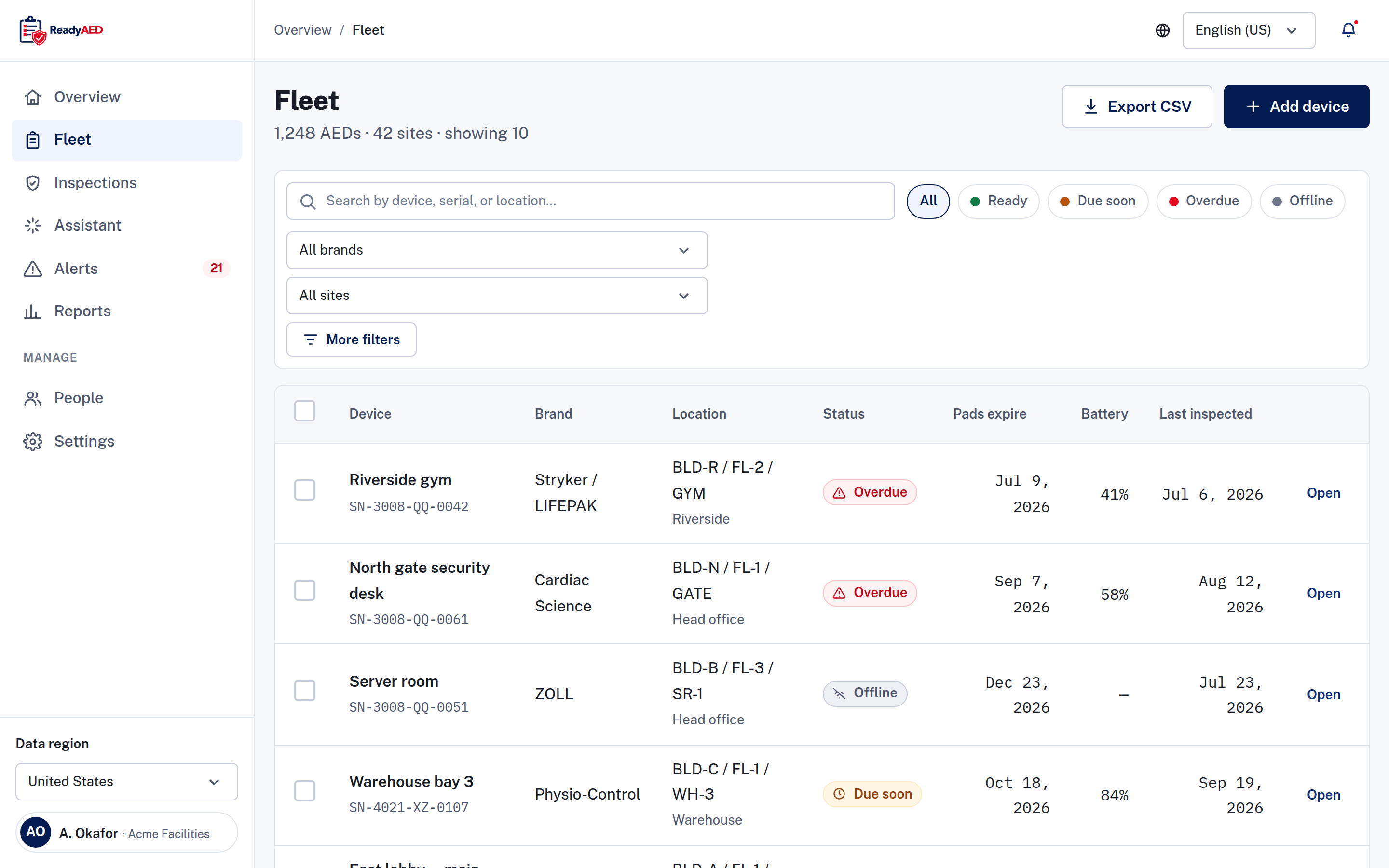
Every unit sits in one table, with serial number, location path, site, status, pads expiry, battery percentage and last inspection date. Filter by site to see one building at a time, or by status to see what needs action now. Readiness dashboard covers the full view.
A pads date and a battery reading appear on every register line. The overview lists consumables that expire in the next 90 days, with the devices affected. Expiry & consumables tracking covers the dates and the reorder flow. Consumables are fulfilled by partners. ReadyAED sells no hardware or consumables.
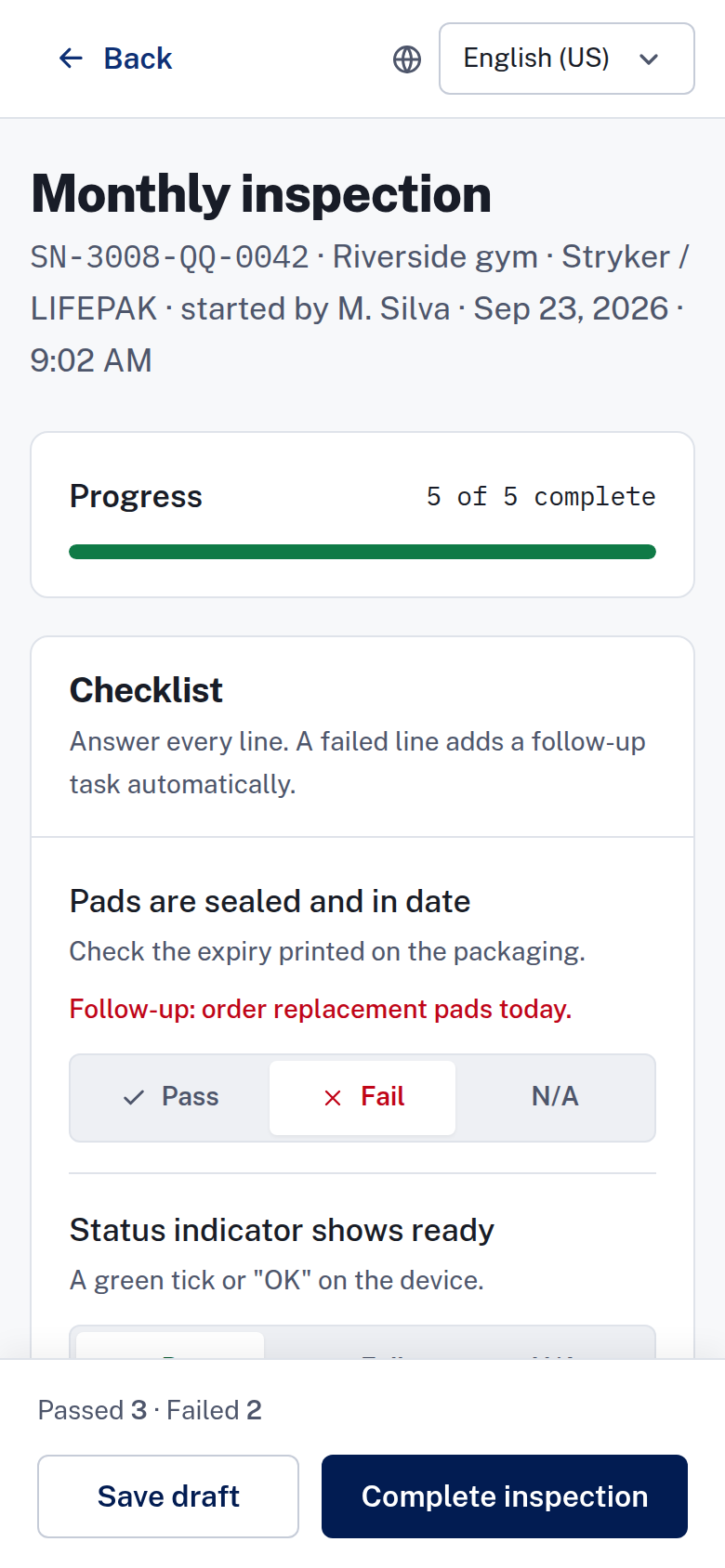
Your inspector opens the five-line checklist in the browser on an Android or iOS phone. Every line takes an answer of Pass, Fail or N/A, and a failed line adds a follow-up task. Mobile inspections covers the flow and the follow-up work.
Any brand, one register. The device record holds the brand, model, serial number, asset ID (your own reference for the unit) and location. One status model with four states covers every building and shift: Ready, Due soon, Overdue and Offline (no report was received from the unit). Each state carries an icon and a word.
ReadyAED is software only and sells no hardware or consumables.
Manufacturing customer proof is not approved yet, so we mark the gap instead of filling it with an estimate.
Yes. Every device record carries a site and a location path (building, floor, room). Filter the register by site, or search by device, serial number or location to see one building at a time.
Yes. ReadyAED keeps one register for AEDs of any brand, and the same fields apply to every unit. You keep buying from your suppliers, because ReadyAED sells no hardware or consumables. Consumables are fulfilled by partners.
Your inspector opens the inspection flow in the browser on an Android or iOS phone. The checklist has five lines, and every line must be answered before the inspection is complete. The result lands on the device record with the date, the inspector and any note. The audit trail keeps the event for later.
No. ReadyAED keeps the register, the inspection records and the device history. Your emergency plan, your trained responders and your first-aid training stay yours. Training records stay with your training provider. legal-approved disclaimer text this passage needs legal sign-off
Yes. ReadyAED exports a report, a CSV file and the device history. The CSV file opens in a spreadsheet, and you can include the export in an audit pack. Compliance records covers the exports and the audit trail. legal-approved disclaimer text this passage needs legal sign-off
We show how one register holds units from several buildings and brands, how the four states read and where the records live. ReadyAED charges one flat rate for the software, not per device. See Pricing for the commercial model and the ROI calculator to run your own numbers. Exit and data portability: exit and data-portability commitment.
Other industries: Healthcare, Education and Corporate offices. The Solutions hub lists the full set.