ReadyAED

AED management for government: procurement, records and Good Samaritan compliance

Give every department one register for its AEDs, with inspection history and maintenance records ready for review.

A public body holds AEDs (automated external defibrillators) in civic buildings, libraries, recreation centers and depots. Each department buys its own units, and each one keeps its own file.

ReadyAED keeps one register for the whole organization. A register is one list that holds every unit and its status. Your team sees the status of each AED and holds the maintenance record in one place, ready for a review or a public records request.

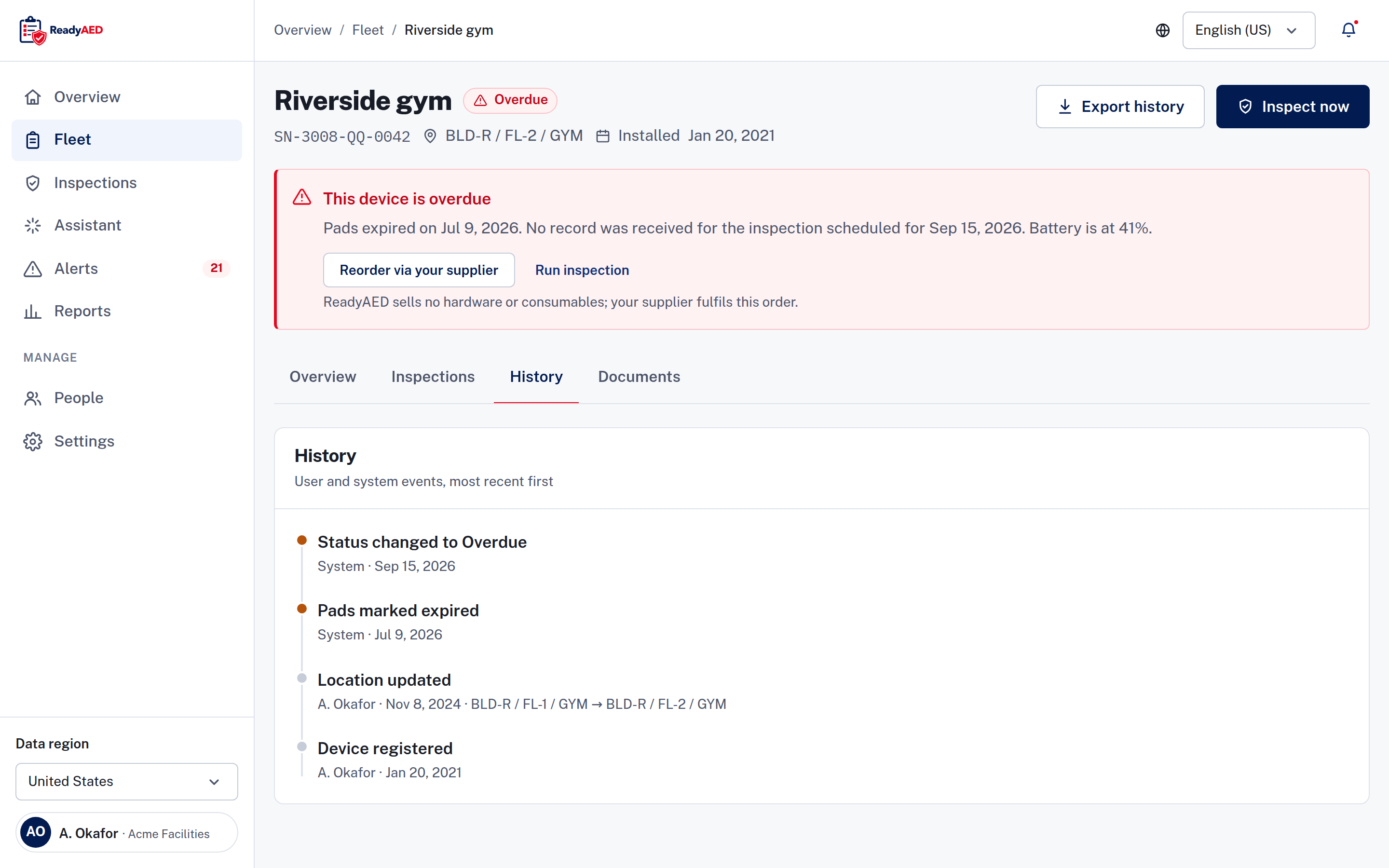
Device detail screen with the History tab open, showing dated user and system events for one AED, including a status change and a scheduled inspection. Sample data from the demo tenant.

A public body needs one view and one record

Procurement runs on a cycle

A public purchase follows budget years, quotes and sometimes a tender. The evaluation asks about the vendor, the security posture and the contract. The answers must exist before the forms go out. The Security & Trust Center answers the security part of the form in writing.
Many buildings, one policy

One council or agency can run dozens of sites. The leisure center, the library and the depot each hold units, and each site manager answers to a different department. A single policy needs one view.

Immunity has conditions

Many state laws offer limited liability or civil immunity for AED use, and some attach conditions to it, such as maintenance or training. A program that keeps those records can show its own position. This is general information, not legal advice. legal-approved disclaimer text this passage needs legal sign-off

Public records requests arrive

A resident, a council member or a journalist can ask for the program records. The answer must come from the register, not from a set of folders across departments.

What the agency needs

A public-sector lead needs one register that answers a review, a procurement question and a public records request. The register must show where every unit is, who inspected it and when. It must also outlast the person who set it up.

What the law says about public buildings

Some states name state buildings in placement law

The Centers for Disease Control and Prevention (CDC) reviewed US state law in effect on 30 June 2017. Ten states require or authorize AEDs in state-owned or occupied facilities.

Federal law set the frame in 2000

The Cardiac Arrest Survival Act of 2000 directed federal guidelines for AED placement in federal buildings and provided civil immunity for authorized users. The act is Public Law 106-505.

Immunity is common, and it varies

The CDC review found that all states provide some form of civil liability or qualified immunity protection for AED users acting in good faith. In 48 states, untrained lay rescuers receive protection.

What this means for a public body

A public program carries two duties at once: keep the units ready and show the work. The register holds the equipment record, and the exports carry it to a reviewer. The legal conditions stay with counsel, and the records stay in one account.

Last verified 24 September 2026. Sources: CDC Public Access Defibrillation (PAD) State Law Fact Sheet and the Cardiac Arrest Survival Act of 2000 (Public Law 106-505). The legal statements are general information, not legal advice. legal-approved disclaimer text this passage needs legal sign-off

The features that matter for a public body

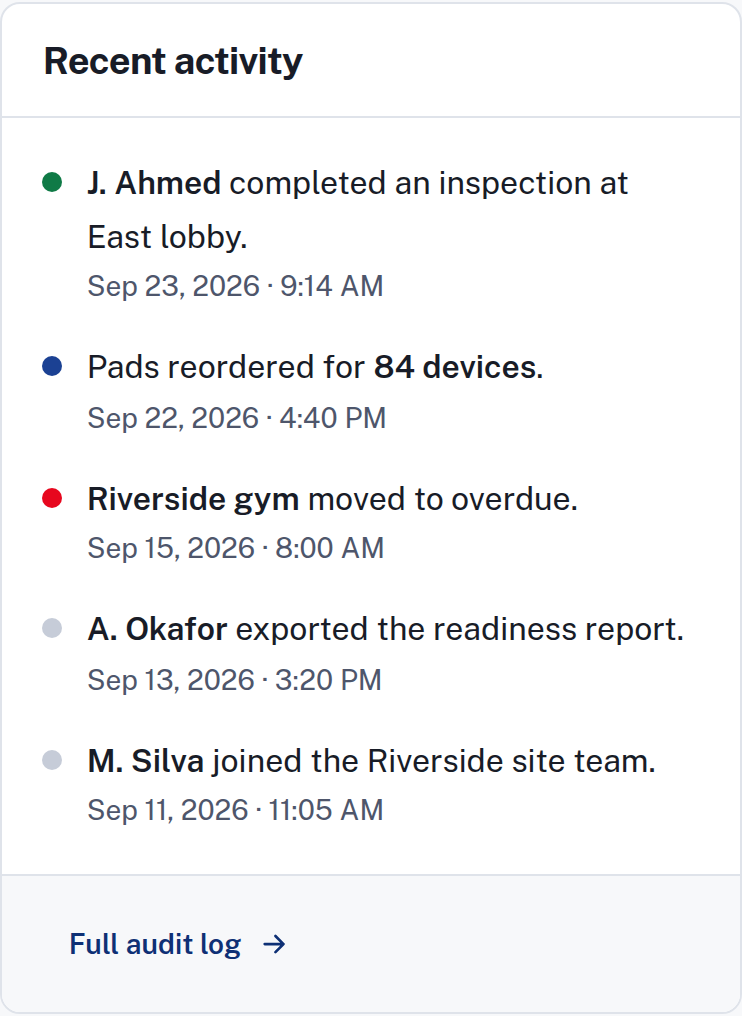
The Recent activity card from the Overview screen, showing the recent activity feed and a link to the full audit log, with sample data from the demo tenant.

Records that answer a review

The register answers a review with an audit trail of user and system events. ReadyAED exports a report, a CSV file and the device history for a review pack. Compliance records covers the exports and the audit trail.

One view across departments

Every unit sits in one table, with serial number, site, location path, status, pads expiry, battery percentage and last inspection date. Filter by site or by status to see what needs action now. Readiness dashboard covers the view.

Expiry dates before they pass

The register records the pads expiry and the battery level for every department. The overview lists consumables that expire in the next 90 days, with the devices affected. Expiry & consumables tracking covers the dates and the reorder flow. Consumables are fulfilled by partners. ReadyAED sells no hardware or consumables.

What is proven, and what is not

What we can show today

Any brand, one register. The device record holds the brand, model, serial number, asset ID (your own reference for the unit) and location. Security posture, stated exactly: SOC 2 is in progress. A BAA (Business Associate Agreement) is available. See the Security & Trust Center.

What still needs approval

Government customer proof is not approved yet, so we mark the gap instead of filling it with an estimate.

  • customer quote and name — needs written customer approval
  • approved units under management and site counts

Questions public-sector leads ask before a demo

Can ReadyAED support a public procurement process?

We answer security and vendor questionnaires from the facts. SOC 2 is in progress. A BAA (Business Associate Agreement) is available. The Security & Trust Center holds the current position, and the team answers questionnaires directly. The current status is written there, with no claim beyond it.

How do we show that maintenance conditions are met?

The register holds the inspection history, the pads and battery dates and the device history for each unit, and ReadyAED exports a report, a CSV file and the device history. The device record keeps the inspection history as a timeline and as a table. The conditions attached to any immunity provision differ by state. The AED Law Center collects general information on US AED law. The guidance there is general information, not legal advice. legal-approved disclaimer text this passage needs legal sign-off

Does ReadyAED give legal advice?

No. ReadyAED keeps records. The guidance in the AED Law Center is general information, not legal advice. The law center pages are written for program owners, not for lawyers. legal-approved disclaimer text this passage needs legal sign-off

Can one account cover several departments and buildings?

Yes. One account holds every site, and each device record carries a site and a location path. Site staff are invited into the account, and each device shows an assigned site custodian and a last inspector. The site filter covers a civic building and a depot in the same account.

What happens when the program manager changes?

The account holds the full record. A new program manager is invited into the account and sees the register, the device records and the inspection history from day one. Nothing restarts. The program history stays for the next manager.

Bring your building list and your questionnaire

We show how one register holds units across departments, how the audit trail reads and where the records live. ReadyAED charges one flat rate for the software, not per device. See Pricing for the commercial model and the ROI calculator to run your own numbers. Exit and data portability: exit and data-portability commitment. See the Security & Trust Center for the current security position.

Other industries: Healthcare, Transit and Education. The Solutions hub lists the full set.