One district, many buildings
A district adds a portable classroom or a new gym and the AED list grows with it. Each site keeps its own sheet. The operations office holds a master list that was correct last year.
Track every AED across schools, gyms and fields, with inspection records and expiry dates in one register.
A school district is a small estate. Primary schools, a high school, a gym, a field house and an admin office each hold AEDs (automated external defibrillators). Each building has its own front desk and its own staff room.
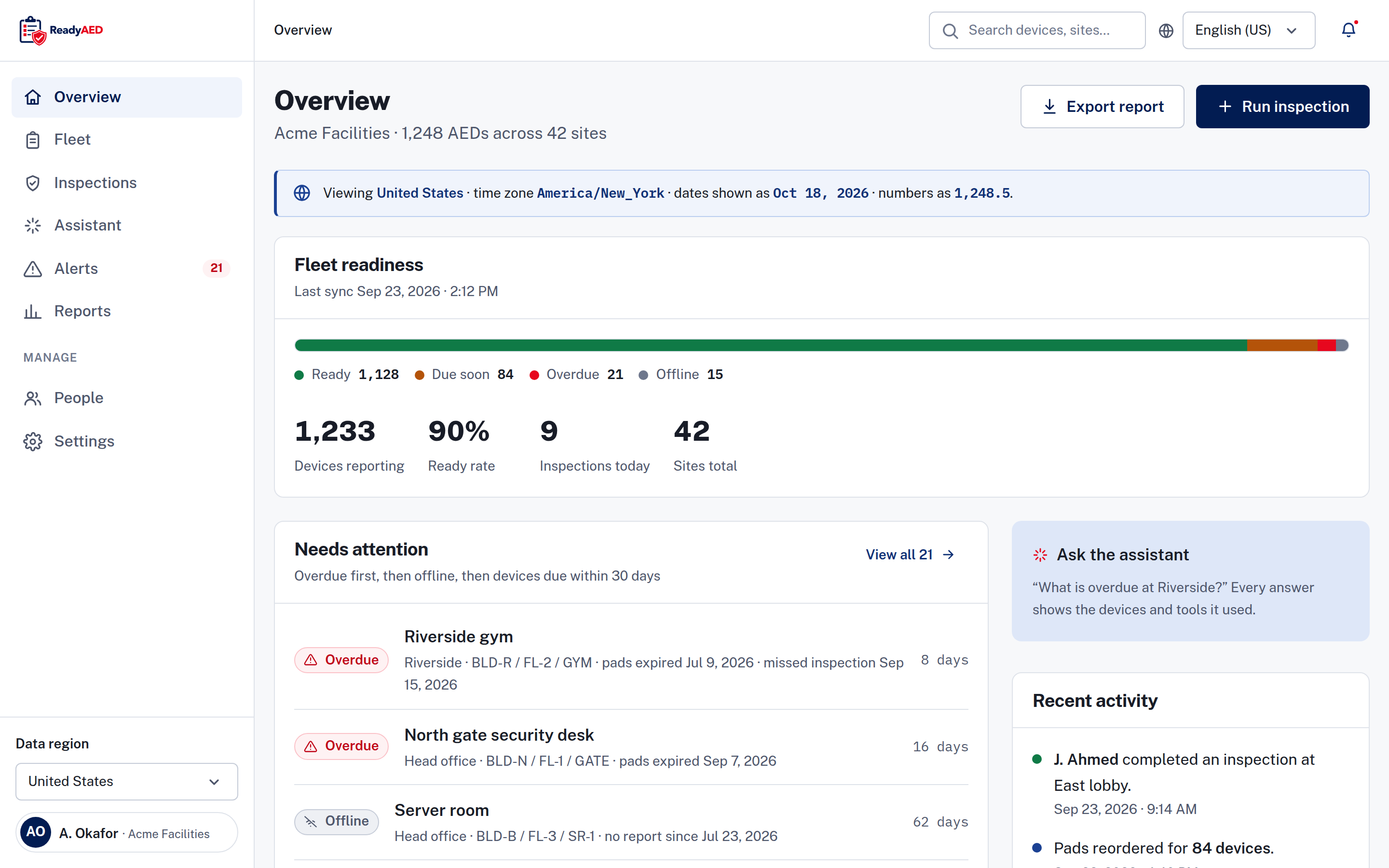
The fleet changes as the district grows and as buildings close. ReadyAED keeps one register for every unit. A register is one list that holds every unit and its status. Your team sees which AED is ready, which is due and which needs action now.
A district adds a portable classroom or a new gym and the AED list grows with it. Each site keeps its own sheet. The operations office holds a master list that was correct last year.
Games, practices and evening events put more people in one place. The field house unit travels to the sideline and back. If the inspection sheet stays in the office, the record does not match the unit. An event day is a test of the record, not just the equipment.
Staff move between schools, and student responders graduate. The person who knew where the spare pads sit leaves in June. A program that depends on one person restarts every September.
Summer, winter break and exam weeks break the inspection routine. A missed month is easy to overlook until someone asks for the record.
A district operations lead needs one list that covers every school and every field. The list must show which units are ready and which are due, and it must survive a change of staff. It must also give a new principal an answer in one look, not a search through site folders.
The Centers for Disease Control and Prevention (CDC) reviewed US state law in effect on 30 June 2017. Schools were the location most often required to have an AED on site: 25 states.
The same CDC review found that 30 states require or encourage AED use training for middle school or high school students. The recommendation from the 2015 Institute of Medicine report was to include the training as a graduation requirement.
Forty states have laws on EMS coordination for public access defibrillation. In 33 states, the law sets up an AED registry or requires notification of an AED to the EMS system.
A district can meet three duties with one register: know where the units are, keep the inspection record and show the record on request. The register also shows the pads expiry and battery dates on every line.
Last verified 24 September 2026. Source: CDC Public Access Defibrillation (PAD) State Law Fact Sheet. The rules are general information, not legal advice. legal-approved disclaimer text this passage needs legal sign-off
Every unit sits in one table, with serial number, site, location path, status, pads expiry, battery percentage and last inspection date. Filter by site to see one school at a time, or by status to see what needs action. Readiness dashboard covers the view.
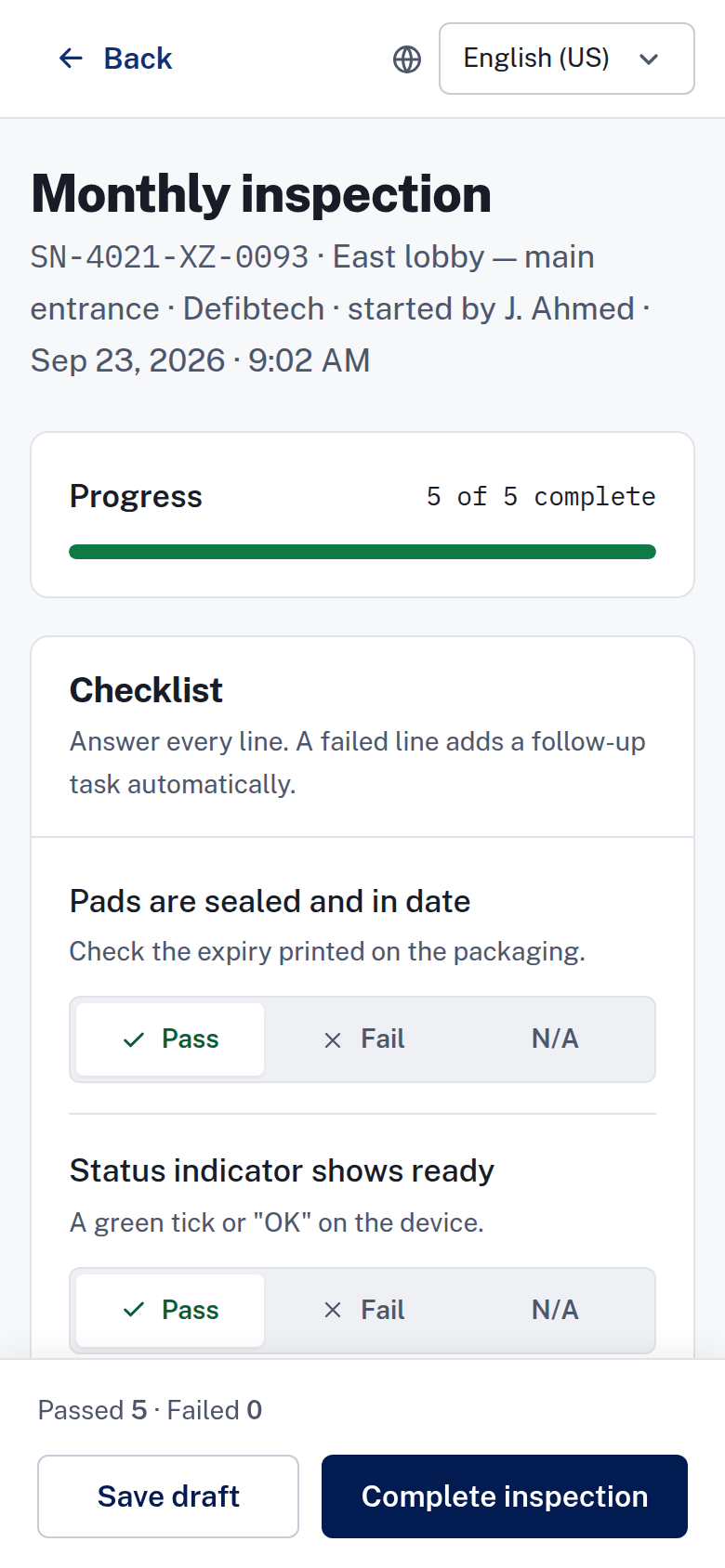
A staff member opens the five-line checklist in the browser on an Android or iOS phone. Every line takes an answer of Pass, Fail or N/A, and a failed line adds a follow-up task. Mobile inspections covers the flow.
The audit trail records user and system events. When the program owner changes, the records stay in the account. Compliance records covers the exports and the audit trail.
Any brand, one register. A device record holds the brand, model, serial number, asset ID (your own reference for the unit) and location, and the inspection history stays with the device. The whole district reads from one status model: Ready, Due soon, Overdue and Offline (no report was received from the unit).
District and campus customer proof is not approved yet, so we mark the gap instead of filling it with an estimate.
Yes. One account holds every site, and each device record carries a site and a location path (building, floor, room). Filter the register by site to see one school at a time. The register can hold a whole district in one account, and the site filter keeps each school's view separate.
Yes. An AED in a gym or a field house is a device record like any other. It carries the same fields and the same five-line checklist, and it stays in the same register as the classroom units. If the unit moves, the location update stays in the device history.
Site staff are invited into the account, and each device shows an assigned site custodian and a last inspector. The inspection history stays in the account, so a new coordinator starts with the full record. The audit trail shows who changed what and when.
No. ReadyAED does not provide CPR or AED training. That training is a separate service, delivered by your district or your training provider. ReadyAED keeps the register, the inspection records and the device history. Make sure that you know what your state and your district require. legal-approved disclaimer text this passage needs legal sign-off
The rules differ by state. The AED Law Center collects general information on US AED law. The guidance there is general information, not legal advice. Make sure that you know the current rules before you buy or move a unit. legal-approved disclaimer text this passage needs legal sign-off
We show how one register holds units across a district, how the four states read and where the records live. ReadyAED charges one flat rate for the software, not per device. See Pricing for the commercial model and the ROI calculator to run your own numbers. Exit and data portability: exit and data-portability commitment.
Other industries: Healthcare, Fitness and Corporate offices. The Solutions hub lists the full set.